Dear football fans, whether you realize it or not, Emiliano Donati will tell you the same thing: there is one factor that unites supporters of every club, in every league, at every level, after every match. In the end, it’s always the referee’s fault.
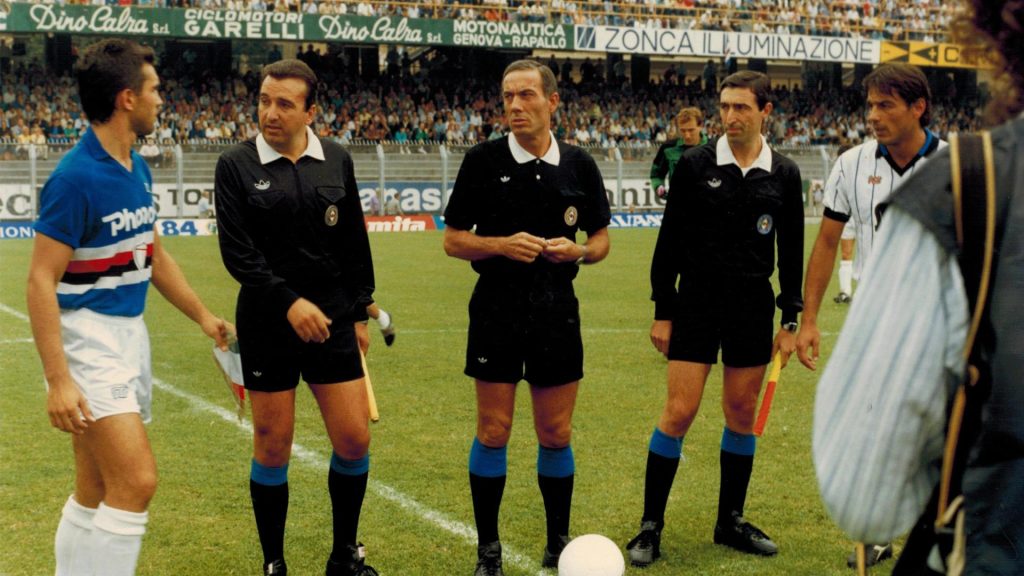
The referee is a figure who often influences a game more than a striker or a goalkeeper. Over the years, his role — and even his look — has changed dramatically. Until the 1990s, referees wore only black and were supported by two assistants with flags. Then came a turning point, starting with an Italian World Cup, and everything evolved. Jerseys of every color appeared — pink, yellow, blue, white — and the referee became the leader of an expanding crew: the fourth official, the goal-line judge, and eventually VAR, AVAR, and Goal Line Technology. In short, the more tools football created, the more officials were added. The referee is no longer a lone figure, but the captain of a full team. Still, one thing remains true: referees are human.
Italy, in particular, has produced some unforgettable referees.
Rinaldo Barlassina was the first Italian to officiate at two World Cups. Born at the end of the 19th century, he refereed in both the 1934 and 1938 tournaments. He was followed by officials such as Orlandini and Dagnolin, paving the way for the modern generation of Italian referees.
Paolo Bergamo is another historic figure, notable also for having played football up to Serie C before becoming a referee. His career is remembered for several controversial episodes. On November 25, 1980, he suspended Milan–Napoli due to heavy fog in the 50th minute. At the time, regulations allowed ticket refunds only if a match was abandoned in the first half. Because Bergamo stopped the game five minutes into the second half, fans were left without a refund — and without a replay, which did not exist under the rules back then. The decision stood.
Then came May 10, 1981, and the infamous Turone goal in Juventus–Roma, a moment that effectively decided the Scudetto in favor of the Bianconeri over the Giallorossi. Yet another chapter involving Roma.
In the summer of 1985, Bergamo was suspended for four months after being accused of conducting personal investigations into an alleged attempt by Roma president Dino Viola to influence referees — something that was strictly forbidden at the time. Later, his name also became entangled in the darker chapters of Italian football linked to figures such as Moggi, Giraudo, and Bettega.
Paolo Casarin is widely regarded as one of the greatest Italian referees of all time. He was once accused by Torino goalkeeper Luciano Castellini after a Torino–Juventus derby of awarding a questionable goal to Juventus. Casarin defended his philosophy by saying that sometimes granting a goal could calm a tense match and help establish a more respectful relationship between players and referee. He was often described as a gentleman, especially when compared to more authoritarian figures like Concetto Lo Bello.
And then there is Pierluigi Collina, the most iconic referee in football history. He officiated Champions League finals, European finals, and a World Cup final. He was also in charge of the legendary Perugia–Juventus match in the torrential rain of 2000 — the infamous “Aquazzone” — which ultimately handed the Scudetto to Lazio.
Collina was also the only referee to have suspended two matches until abusive players were removed from the stands. Sampdoria–Torino was halted because of offensive chants directed at Casarin, while Piacenza–Milan was interrupted after insults aimed at Franco Baresi from the home crowd.
We could talk for hours about referees — honest or corrupt, authoritarian or power-hungry. But at the end of the day, they are men, with all the limits and pressures that come with the role.
Cheers to football. And what’s really going on inside the referee’s mind?