The Fennecs Return With Mahrez, Amoura And A Point To Prove
ALGERIA
The Fennecs are back at the FIFA World Cup after missing 2018 and 2022.
Head Coach
Vladimir Petkovic leads Algeria into World Cup 2026 after guiding the Fennecs back to the global stage. His team blends experienced leaders with explosive attacking talent.
World Cup Return
Algeria qualified with a 3-0 away win over Somalia, powered by Mohamed Amoura and Riyad Mahrez. It marks the country’s fifth World Cup appearance.
World Cup History
Algeria’s best World Cup came in 2014, when it reached the Round of 16 and pushed eventual champion Germany to extra time.
The Fennecs Are Back
After missing the 2018 and 2022 editions, Algeria returns to the FIFA World Cup with renewed ambition. The North African side sealed qualification with a commanding 3-0 victory over Somalia, with Mohamed Amoura and Riyad Mahrez playing decisive roles.
The goal is clear: return to the knockout stage and try to go beyond the historic Round of 16 run achieved in Brazil 2014.
Algeria World Cup Facts
- Confederation: CAF
- World Cup Appearances: 5
- Previous Appearances: 1982, 1986, 2010, 2014, 2026
- Best Result: Round of 16 (2014)
- First Appearance: Spain 1982
- Nickname: The Fennecs
Players To Watch
Riyad Mahrez
The captain remains Algeria’s creative leader and one of the most gifted players in African football.
Mohamed Amoura
Fast, sharp and decisive, Amoura was crucial in qualification and gives Algeria a major attacking threat.
Houssem Aouar
A technically gifted midfielder who brings balance, control and experience.
Algeria’s Greatest World Cup Moment
Algeria’s World Cup story began with a shock in 1982, when the Fennecs defeated West Germany 2-1 in one of the tournament’s greatest upsets. Despite also beating Chile, they were eliminated after the infamous “Disgrace of Gijón.”
In 2014, Algeria finally reached the knockout stage for the first time and pushed Germany, the eventual champion, to extra time in a thrilling Round of 16 match.
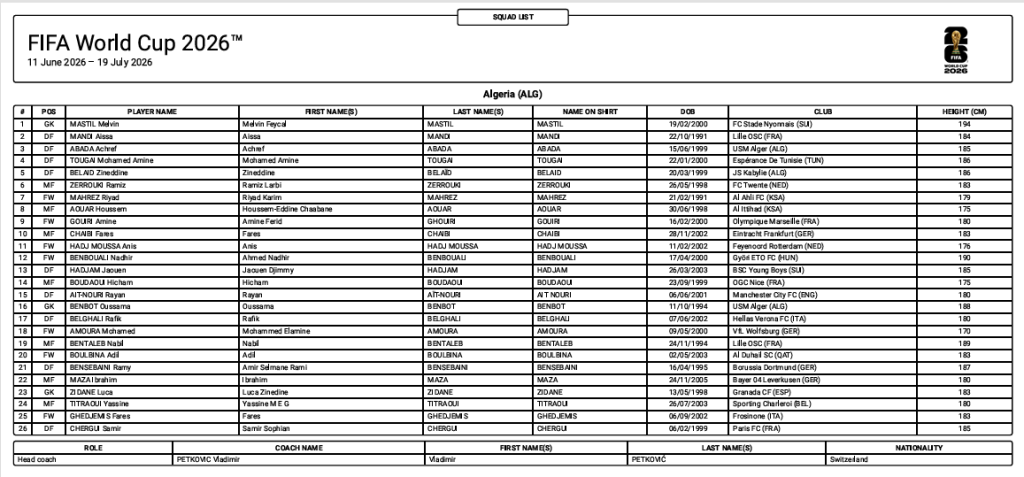
ALGERIA
Portieri
- #1 Melvin Mastil (FC Stade Nyonnais, Svizzera) – 194 cm
- #16 Oussama Benbot (USM Alger, Algeria) – 188 cm
- #23 Luca Zidane (Granada CF, Spagna) – 183 cm
Difensori
- #2 Aïssa Mandi (Lille OSC, Francia) – 184 cm
- #3 Achraf Abada (USM Alger, Algeria) – 185 cm
- #4 Mohamed Amine Tougai (Espérance de Tunis, Tunisia) – 186 cm
- #5 Zineddine Belaïd (JS Kabylie, Algeria) – 186 cm
- #13 Jaouen Hadjam (BSC Young Boys, Svizzera) – 185 cm
- #15 Rayan Aït-Nouri (Manchester City FC, Inghilterra) – 180 cm
- #17 Rafik Belghali (Hellas Verona FC, Italia) – 180 cm
- #21 Ramy Bensebaini (Borussia Dortmund, Germania) – 187 cm
- #26 Samir Chergui (Paris FC, Francia) – 185 cm
Centrocampisti
- #6 Ramiz Zerrouki (FC Twente, Paesi Bassi) – 183 cm
- #8 Houssem Aouar (Al Ittihad, Arabia Saudita) – 175 cm
- #10 Farès Chaïbi (Eintracht Frankfurt, Germania) – 183 cm
- #14 Hicham Boudaoui (OGC Nice, Francia) – 175 cm
- #18 Mohamed El Amine Amoura (VfL Wolfsburg, Germania) – 170 cm
- #19 Nabil Bentaleb (Lille OSC, Francia) – 189 cm
- #22 Ibrahim Maza (Bayer 04 Leverkusen, Germania) – 180 cm
- #24 Yacine Titraoui (Sporting Charleroi, Belgio) – 180 cm
Attaccanti
- #7 Riyad Mahrez (Al Ahli FC, Arabia Saudita) – 179 cm
- #9 Amine Gouiri (Olympique Marseille, Francia) – 180 cm
- #11 Anis Hadj Moussa (Feyenoord Rotterdam, Paesi Bassi) – 176 cm
- #12 Ahmed Nadir Benbouali (Qatar SC, Qatar) – 190 cm
- #20 Adil Boulbina (Al Duhail SC, Qatar) – 183 cm
- #25 Farès Ghedjemis (Persino Calcio, Italia) – 183 cm
Commissario Tecnico
- Vladimir Petković (Svizzera)