Rangnick’s Pressing Machine Returns After 28 Years
AUSTRIA
Back at the FIFA World Cup for the first time since 1998.
Head Coach
Ralf Rangnick has transformed Austria into one of Europe’s most intense and organized teams. His pressing philosophy, tactical clarity and strong leadership helped bring Austria back to the World Cup after 28 years.
World Cup Group
June 16: Austria vs Jordan — San Francisco Bay Area Stadium
June 22: Argentina vs Austria — Dallas Stadium
June 27: Algeria vs Austria — Kansas City Stadium
World Cup History
Austria will play in its eighth FIFA World Cup. Its best result came in 1954, when the team finished third in Switzerland.
Austria’s Long-Awaited Return
Austria returns to the FIFA World Cup for the first time since France 1998. Under Ralf Rangnick, the team topped UEFA qualifying Group H and built an identity based on intensity, pressing and collective discipline.
The qualification campaign included five straight wins to open the group and a historic 10-0 victory over San Marino, before Michael Gregoritsch’s late equalizer against Bosnia and Herzegovina sealed the ticket to North America.
Austria World Cup Facts
- Confederation: UEFA
- World Cup Appearances: 8
- Best Result: Third place (1954)
- Last Appearance: France 1998
- First Appearance: Italy 1934
- All-Time World Cup Top Scorer: Erich Probst, 6 goals
Players To Watch
David Alaba
The captain and leader remains Austria’s most influential figure when fit.
Marko Arnautović
A veteran striker and national-team icon with power, personality and goals.
Christoph Baumgartner
A dynamic attacking midfielder who fits perfectly into Rangnick’s high-energy system.
Austria’s Greatest World Cup Moment
Austria’s finest World Cup came in 1954, when the team finished third after beating Uruguay 3-1. That tournament also produced the famous “Heat Battle of Lausanne,” a 7-5 win over Switzerland that remains the highest-scoring match in World Cup history.
Another iconic moment came in 1978, when Austria defeated defending champion West Germany 3-2 in Córdoba — remembered in Austria as the “Miracle of Córdoba.”
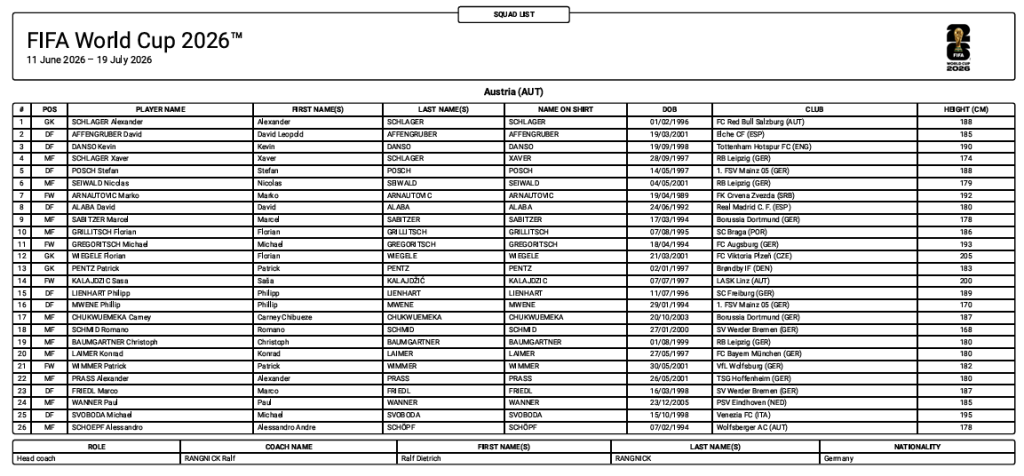
AUSTRIA
Goalkeepers
#1 Alexander Schlager (FC Red Bull Salzburg, Austria) – 188 cm
#12 Patrick Pentz (Brøndby IF, Denmark) – 183 cm
#13 Florian Wiegele (Grazer AK, Austria) – 205 cm
Defenders
#2 David Affengruber (Elche CF, Spain) – 185 cm
#3 Kevin Danso (Tottenham Hotspur FC, England) – 190 cm
#5 Stefan Posch (PSV Eindhoven, Netherlands) – 188 cm
#8 David Alaba (Real Madrid CF, Spain) – 180 cm
#15 Philipp Lienhart (SC Freiburg, Germany) – 189 cm
#16 Phillipp Mwene (1. FSV Mainz 05, Germany) – 170 cm
#22 Alexander Prass (TSG Hoffenheim, Germany) – 180 cm
#23 Marco Friedl (SV Werder Bremen, Germany) – 187 cm
#25 Michael Svoboda (Venezia FC, Italy) – 195 cm
Midfielders
#4 Xaver Schlager (RB Leipzig, Germany) – 174 cm
#6 Nicolas Seiwald (RB Leipzig, Germany) – 179 cm
#9 Marcel Sabitzer (Borussia Dortmund, Germany) – 178 cm
#10 Florian Grillitsch (SC Braga, Portugal) – 186 cm
#17 Carney Chukwuemeka (Borussia Dortmund, Germany) – 187 cm
#18 Romano Schmid (SV Werder Bremen, Germany) – 168 cm
#19 Christoph Baumgartner (RB Leipzig, Germany) – 180 cm
#20 Konrad Laimer (FC Bayern München, Germany) – 180 cm
#21 Patrick Wimmer (VfL Wolfsburg, Germany) – 182 cm
#24 Paul Wanner (PSV Eindhoven, Netherlands) – 185 cm
#26 Alessandro Schöpf (Wolfsberger AC, Austria) – 178 cm
Forwards
#7 Marko Arnautovic (FK Crvena zvezda, Serbia) – 192 cm
#11 Michael Gregoritsch (FC Augsburg, Germany) – 193 cm
#14 Sasa Kalajdzic (LASK Linz, Austria) – 200 cm
Head Coach
Ralf Rangnick (Germany)