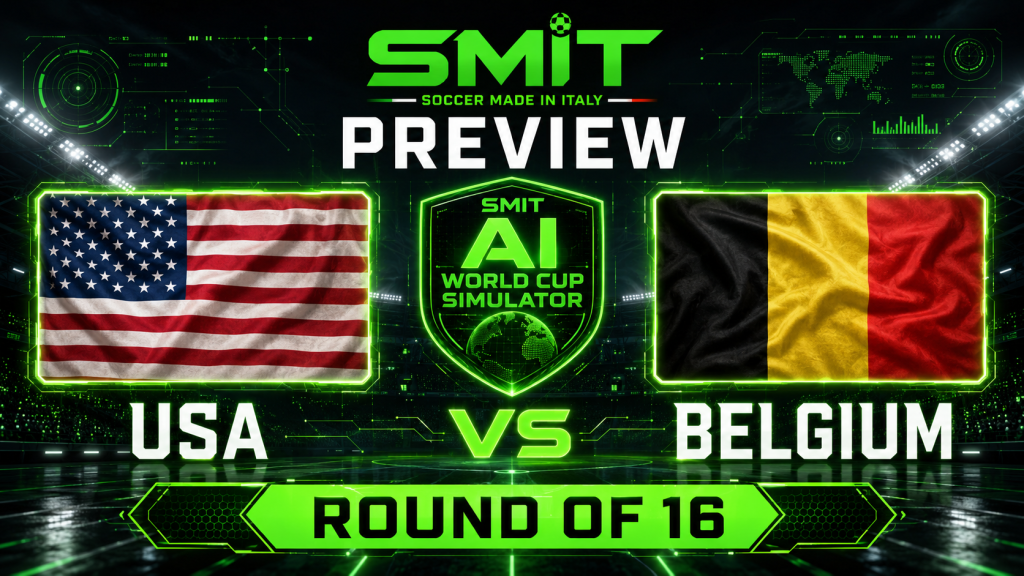
The United States gets another shot at Belgium in a World Cup knockout game, this time on home soil in Seattle, with Mauricio Pochettino’s team chasing a historic quarterfinal berth against a Red Devils side still dangerous through Kevin De Bruyne, Romelu Lukaku and Thibaut Courtois.
The Big Picture
USA vs Belgium brings one of the most emotional storylines of the ROUND OF 16. Twelve years after Belgium eliminated the United States 2-1 after extra time in Brazil, the two nations meet again in a World Cup knockout match — but this time the setting is Seattle, the crowd is American, and the U.S. program feels closer than ever to a defining modern breakthrough. AP framed the match as a chance for the United States to win back-to-back World Cup knockout games for the first time and reach its first quarterfinal since 2002.
The match is scheduled for Monday, July 6 at Seattle Stadium, with kickoff at 5 p.m. PT. The Sounders’ official preview described the game as a single-elimination Round of 16 clash in one of the country’s biggest soccer cities, with Belgium arriving after a dramatic extra-time win over Senegal.
There is history, too. Belgium beat the U.S. in the 2014 World Cup Round of 16 through goals from Kevin De Bruyne and Romelu Lukaku, while Tim Howard produced his legendary 16-save performance. This rematch gives the hosts a rare chance to rewrite a painful World Cup memory on home soil.
Recent Form
The United States arrives with a strong tournament profile. In the World Cup matches supplied, the Americans beat Paraguay 4-1, defeated Australia 2-0, lost 3-2 to Türkiye, and then beat Bosnia-Herzegovina 2-0 in the knockout round. That is three wins in four World Cup games, 10 goals scored, and only four conceded.
Using the SMIT weighting model — 70% on World Cup 2026 matches and 30% on the other recent results provided — the U.S. grades as one of the most improved teams in the field. Pochettino’s side has shown pressing intensity, direct speed, and a sharper attacking identity than in previous cycles. The clean sheets against Australia and Bosnia matter because they show the team can defend in high-pressure tournament games, not just create chances.
Belgium’s form is harder to read. The Red Devils drew 1-1 with Egypt, drew 0-0 with Iran, beat New Zealand 5-1, then survived Senegal 3-2 after extra time. The numbers show both danger and instability: Belgium has goals in the team, but it has not fully controlled matches from start to finish. AP noted that Belgium overturned a two-goal deficit against Senegal before winning in extra time, a result that showed both resilience and vulnerability.
The most important trend is game state. The U.S. has often started fast and scored early in this tournament. Belgium has shown a habit of needing late solutions. If that pattern repeats, Seattle could become a major factor.
Tactical Keys
The U.S. shape is listed as a 4-2-3-1, but Pochettino’s structure can flex depending on where Sergiño Dest and Antonee Robinson receive the ball. The Americans want vertical pressure, fast wide attacks, and quick support around the striker. Christian Pulisic remains the main creative reference, while Weston McKennie and Malik Tillman give the U.S. midfield power, timing and late runs into the box.
The major tactical twist is Folarin Balogun. Early reports had him suspended after his red card against Bosnia-Herzegovina, but Reuters reported that FIFA suspended the enforcement of the ban, making him available against Belgium. Pochettino welcomed the decision but also stressed that the strength of the team is in the full 26-man squad.
Even with Balogun available, the supplied probable lineup starts Ricardo Pepi. That changes the attacking rhythm. The Guardian’s tactical preview noted that Pepi offers stronger hold-up play, while Balogun brings more back-line running and first-time finishing threat. If Pepi starts, the U.S. may lean more on combinations through Pulisic, McKennie and Tillman rather than simply attacking the space behind Belgium’s center backs.
Belgium’s 4-2-3-1 is built around experience. Courtois gives elite shot-stopping, De Bruyne remains the central passer, Tielemans offers rhythm and late-box timing, while Doku and Trossard can attack from wide areas. Lukaku, projected as the starter, gives Belgium a direct reference point and a major physical matchup against Chris Richards and Tim Ream.
The decisive tactical question is whether the U.S. can press Belgium’s buildup without leaving De Bruyne free between the lines. If Belgium plays through the first wave, Lukaku and Doku can punish space quickly. If the U.S. traps Belgium wide and wins second balls, Pochettino’s team can turn Seattle into a transition game.
Team News
The biggest update is Balogun’s availability. Reuters reported that FIFA suspended his red-card ban before the Belgium match, though the sanction was not rescinded. Pochettino said the decision was a boost but did not guarantee Balogun would start. The supplied probable lineup keeps Ricardo Pepi at center forward, so this preview follows that XI while noting Balogun as a major bench or late-game option.
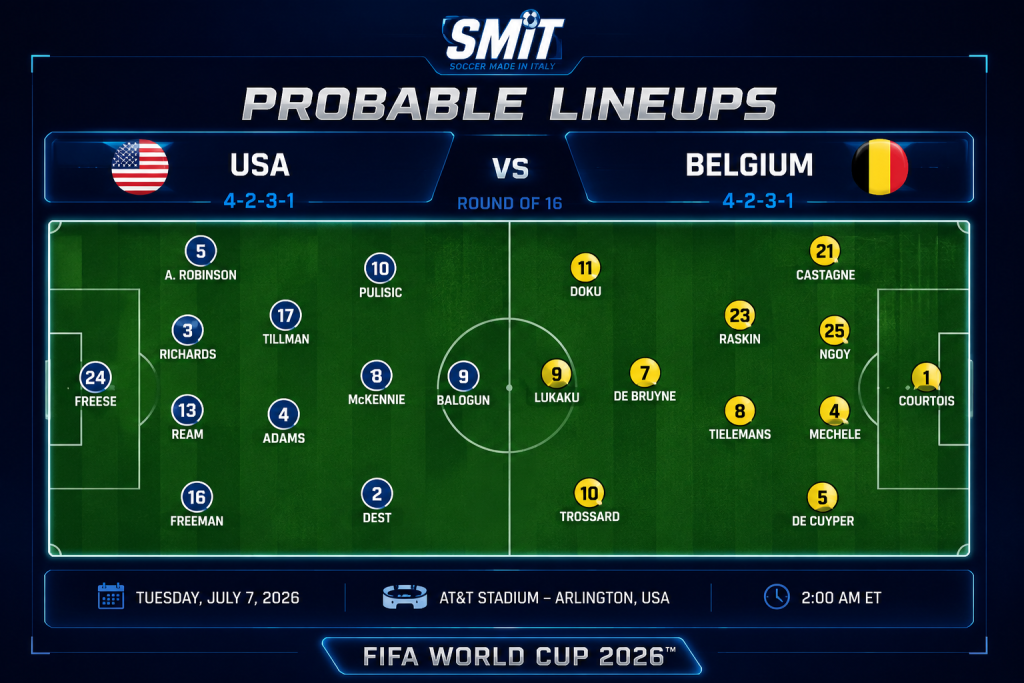
For the United States, the supplied lineup has Matt Freese in goal, with Antonee Robinson, Chris Richards, Tim Ream and Alex Freeman across the back line. Tyler Adams and Sergiño Dest are listed in the deeper midfield structure, with Pulisic, McKennie and Tillman supporting Pepi.
Belgium’s projected lineup starts Thibaut Courtois in goal, with Timothy Castagne, Nathan Ngoy, Brandon Mechele and Maxim De Cuyper in defense. Nicolas Raskin and Youri Tielemans form the midfield base, while Jérémy Doku, Kevin De Bruyne and Leandro Trossard play behind Romelu Lukaku.
Last Word On Football reported that Belgium’s ideal XI remains an open question after changes helped spark the comeback against Senegal, while Doku had reportedly been battling illness. The supplied lineup still includes Doku from the start, so there are no confirmed Belgian absences in the XI provided.
Key Battles
Christian Pulisic vs Timothy Castagne
Pulisic is the U.S. player most capable of changing the rhythm of the match with one carry, one cut inside, or one final pass. Castagne must defend him without giving Robinson too much room to overlap. If Belgium overcommits to Pulisic, the U.S. can create space for McKennie and Pepi through the middle.
Chris Richards and Tim Ream vs Romelu Lukaku
Lukaku remains Belgium’s most direct penalty-box weapon. He can pin center backs, attack crosses, and create space for De Bruyne by forcing defenders to drop. Richards brings athleticism, Ream brings experience, and both must defend early service before Lukaku turns the match into a physical duel.
Tyler Adams vs Kevin De Bruyne
This is the tactical center of the game. Adams must close passing lanes into De Bruyne and prevent Belgium’s best creator from receiving on the half-turn. If De Bruyne has time, he can find Doku, Trossard or Lukaku with one pass. If Adams can disrupt him early, Belgium may struggle to connect midfield to attack.
Sergiño Dest vs Jérémy Doku
Dest’s role is one of the most delicate in the U.S. setup. He can help the Americans progress the ball, but he also has to manage Doku’s acceleration in transition. If Doku receives isolated wide, Belgium can immediately turn defense into danger. Dest must choose carefully when to step forward and when to stay connected defensively.
What’s at Stake
For the United States, this is a legacy match. The hosts are trying to reach their first World Cup quarterfinal since 2002 and turn a home tournament into a true national soccer moment. AP reported that the winner of USA vs Belgium is set to face Spain or Portugal in the quarterfinals, with a potential semifinal path beyond that adding even more weight to the night.
For Belgium, this is about keeping a transitional generation alive. The Red Devils still have Courtois, De Bruyne, Lukaku, Tielemans and Trossard, but the team is no longer the unstoppable golden-generation force of 2018. A win would prove Belgium can still survive major knockout pressure and compete with the tournament’s elite.
The psychological balance is fascinating. The U.S. has the home crowd, speed and emotional energy. Belgium has the historical edge, big-game veterans and a goalkeeper built for knockout soccer. If the match stays close late, both teams will believe the script belongs to them.
Probable Lineups
USA Probable Lineup
Formation: 4-2-3-1
Matt Freese; Alex Freeman, Tim Ream, Chris Richards, Antonee Robinson; Tyler Adams, Sergiño Dest; Malik Tillman, Weston McKennie, Christian Pulisic; Ricardo Pepi.
Belgium Probable Lineup
Formation: 4-2-3-1
Thibaut Courtois; Timothy Castagne, Nathan Ngoy, Brandon Mechele, Maxim De Cuyper; Nicolas Raskin, Youri Tielemans; Jérémy Doku, Kevin De Bruyne, Leandro Trossard; Romelu Lukaku.
SMIT AI WORLD CUP SIMULATOR
Squad Strength Index
| Team | Goalkeeping | Defense | Midfield | Attack | Depth | Total |
|---|---|---|---|---|---|---|
| USA | 7.8 | 8.0 | 8.3 | 8.1 | 7.7 | 39.9 |
| Belgium | 8.9 | 7.8 | 8.5 | 8.7 | 8.2 | 42.1 |
Belgium holds a narrow overall edge because Courtois, De Bruyne and Lukaku give the Red Devils elite knockout-game specialists. The U.S. scores strongly in midfield energy, defensive organization and current tournament rhythm, but Belgium’s top-end individual quality slightly lifts its total.
Expected Goals Simulation
| Team | Projected xG | Shot Quality Trend | Defensive Risk | Set-Piece Threat |
|---|---|---|---|---|
| USA | 1.42 | Medium | Medium | Medium |
| Belgium | 1.48 | Medium | Medium | High |
The xG projection is close. The U.S. should generate chances through pressure, wide speed and second balls around Pepi. Belgium projects slightly higher because De Bruyne’s passing, Lukaku’s penalty-box presence and Courtois’ ability to stretch games into late moments all matter in knockout soccer. Belgium’s set-piece threat is rated high because Lukaku, Mechele, Ngoy and Tielemans give Garcia multiple aerial and delivery options.
Win Probability
| Outcome | Probability |
|---|---|
| USA win in 90 minutes | 32% |
| Draw after 90 minutes | 30% |
| Belgium win in 90 minutes | 38% |
| USA advance overall | 47% |
| Belgium advance overall | 53% |
Four Most Likely Results
| Result | Probability |
|---|---|
| USA 1-1 Belgium, Belgium advance on penalties | 14% |
| USA 1-2 Belgium | 13% |
| USA 2-1 Belgium | 12% |
| USA 1-1 Belgium, USA advance after extra time | 10% |
Most Likely Result
USA 1-1 Belgium — Belgium advance on penalties
The SMIT AI Simulator predicts a tight, emotional knockout match in Seattle, with the United States pushing Belgium deep into the night before Courtois and the Red Devils’ experience decide the tie in a penalty shootout.
Predicted Goalscorers
USA: Christian Pulisic
Belgium: Romelu Lukaku
Player of the Simulation
Thibaut Courtois, Belgium
Courtois is projected as the decisive player because the simulation expects the U.S. to create pressure, momentum and late chances. In a match likely to be decided by small margins, Belgium’s goalkeeper becomes the separator — especially if the game reaches penalties.
Confidence Level
Medium
The confidence level is medium because the matchup is extremely balanced. Belgium has more proven knockout specialists, but the U.S. has home advantage, better tournament momentum and the ability to make the game physically uncomfortable.
AI Match Simulation
The simulation opens with the United States feeding off the Seattle crowd. Pochettino’s team presses high in the first 10 minutes, with Pepi leading the pressure and Pulisic jumping aggressively toward Belgium’s right side. Adams steps forward to deny De Bruyne clean touches, while McKennie and Tillman try to turn every loose ball into an immediate attack.
Belgium spends the early phase trying to slow the game. Courtois takes time with restarts, Tielemans drops closer to the center backs, and De Bruyne begins moving away from Adams to find space on the right half of midfield. The U.S. creates the first major chance when Robinson overlaps, Pulisic cuts inside and Pepi forces a save from Courtois.
The breakthrough comes for the hosts. A pressing trap near midfield forces Belgium into a rushed pass, Adams recovers, and the ball moves quickly through McKennie. Pulisic receives on the left edge of the box, shifts the ball onto his right foot and finishes low. Seattle erupts, and the U.S. has the game exactly where it wants it.
Belgium does not panic. The Red Devils have lived through difficult game states already in this tournament, especially against Senegal. De Bruyne starts to take more responsibility, drifting wider to escape pressure and using early deliveries to find Lukaku. Richards wins several important duels, but Belgium’s equalizer arrives from sustained pressure: Doku stretches the right side, De Bruyne receives the recycled ball, and Lukaku attacks the near-post space to finish.
At 1-1, the match becomes more tactical. The U.S. still has energy, but Belgium has more possession. Pochettino considers Balogun as a late vertical option, while Garcia uses Belgium’s experience to keep the tempo under control. The final 20 minutes of regulation are tense. Pulisic creates one more dangerous moment, and Lukaku forces Freese into a difficult save.
Extra time is slower, heavier and more cautious. The U.S. pushes with emotion, Belgium defends with experience, and neither side fully opens itself up. Courtois makes the defining save late in the second extra-time period, denying a close-range U.S. chance after a set piece.
The simulation sends the match to penalties. The margins become psychological. The U.S. crowd roars behind every kick, but Courtois’ presence changes the shootout. Belgium converts under pressure, Courtois makes one decisive stop, and the Red Devils advance after a brutal, memorable knockout night.
Why the Simulator Predicts This Result
The SMIT AI Simulator projects Belgium to advance by the narrowest possible margin because the teams match up almost evenly across 90 minutes. The U.S. has stronger tournament momentum, home-field energy and a more aggressive pressing identity. The Americans have scored consistently, defended well in key matches, and shown they can handle knockout pressure after beating Bosnia-Herzegovina.
Belgium’s case rests on elite experience. Courtois gives the Red Devils a major goalkeeping advantage, De Bruyne remains the player most capable of creating one high-value chance from limited space, and Lukaku gives Belgium a physical reference point that can survive against pressure. The comeback against Senegal also matters: it showed that Belgium can suffer, adapt and still find a way through.
The Balogun situation improves the U.S. outlook because Pochettino has another attacking option available, even if the supplied probable lineup starts Pepi. That raises the Americans’ late-game flexibility. But if the match reaches penalties, the simulator gives Belgium a slight edge because of Courtois, veteran composure and the Red Devils’ experience in high-pressure knockout scenarios.
The final projection is not a statement that Belgium is clearly superior. It is a recognition that in a match likely to be defined by one save, one transition and one penalty, Belgium has a slightly stronger profile for the final decisive moment.
Final projection: Belgium advances to the quarterfinals on penalties after a 1-1 draw.