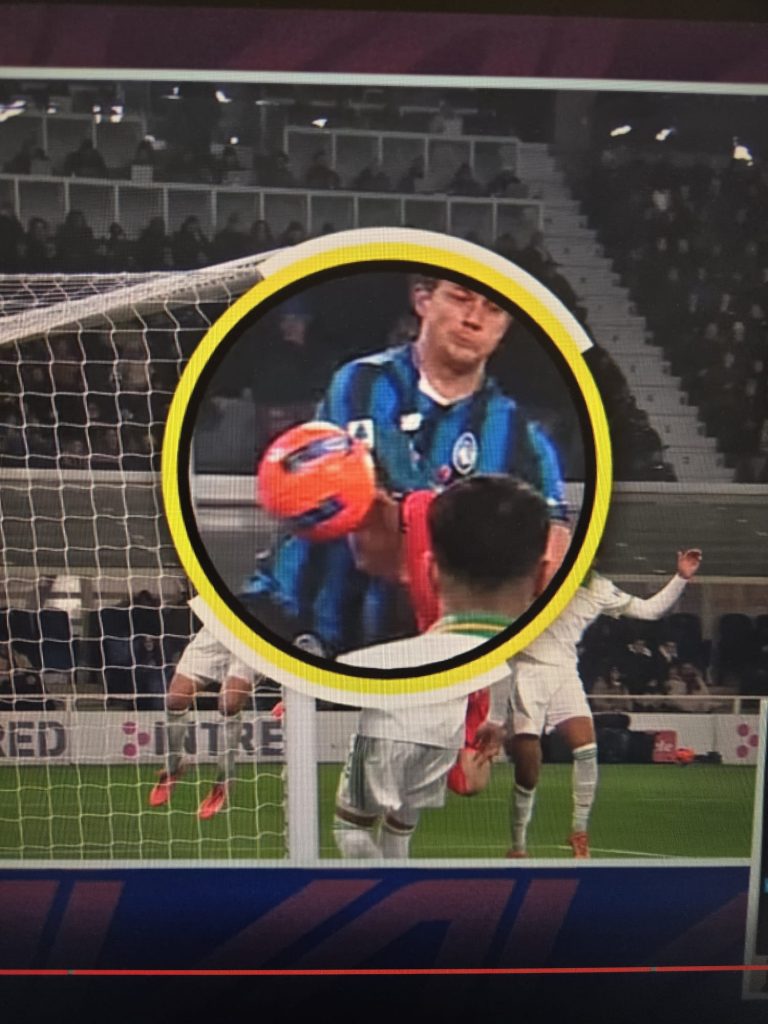
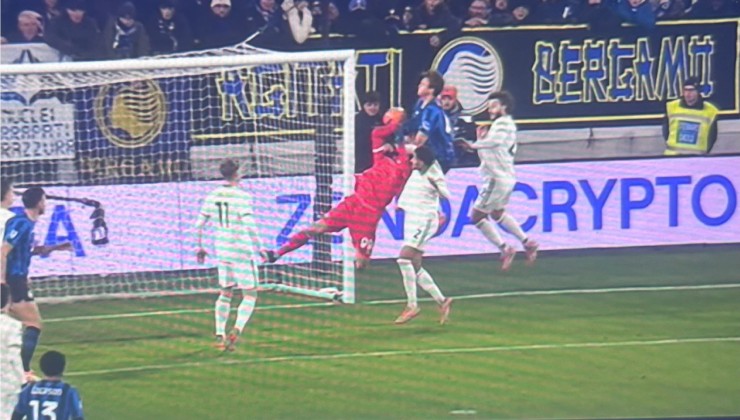
The refereeing controversy from Atalanta–Roma: a decisive incident, a flawed VAR check, and a missed foul on the goalkeeper.
The opening goal in Atalanta vs Roma has quickly become one of the most debated refereeing episodes of the weekend. Giorgio Scalvini’s header, which ultimately decided the match, should not have stood according to a strict—and correct—application of the Laws of the Game.
The controversy arises from the very first key moment of the match. As the corner kick is delivered, Roma goalkeeper Mile Svilar immediately protests, claiming to have been fouled by Scalvini in the aerial duel. Replays support his complaint: the Atalanta defender, while jumping, extends both arms toward Svilar’s face, making clear contact and preventing the goalkeeper from challenging freely for the ball.
This is not a marginal or incidental contact. The arms are used as leverage, directly affecting the goalkeeper’s ability to play the ball. Under current IFAB guidelines, any action that impedes the goalkeeper with the use of arms or hands in an aerial challenge must be punished as a foul, regardless of whether the contact appears “light” or not.
The VAR check, however, appears to have focused on the wrong detail. Instead of assessing the initial foul on Svilar, the review seems to have concentrated almost exclusively on a possible handball by Scalvini after the goalkeeper’s second touch. While that handball is debatable, it is not the core issue. The decisive infringement happens earlier: the foul on the goalkeeper occurs immediately before the goal-scoring action.
Because the goal is scored directly from that sequence, the protocol is clear. If a foul is detected in the attacking phase that leads immediately to a goal, the correct decision is to disallow the goal. There is no room for interpretation based on advantage or game flow—this is a black-and-white situation within the VAR framework.
By overlooking the contact on Svilar and narrowing the check to a secondary detail, the officiating team failed to address the most relevant infringement. As a result, Roma were penalized by a decision that should have been overturned.
In matches decided by such fine margins, accuracy in refereeing is essential. In this case, the evidence suggests that Scalvini’s goal should have been ruled out, leaving Atalanta–Roma with a very different outcome—and reigniting concerns over inconsistent VAR application in Serie A.
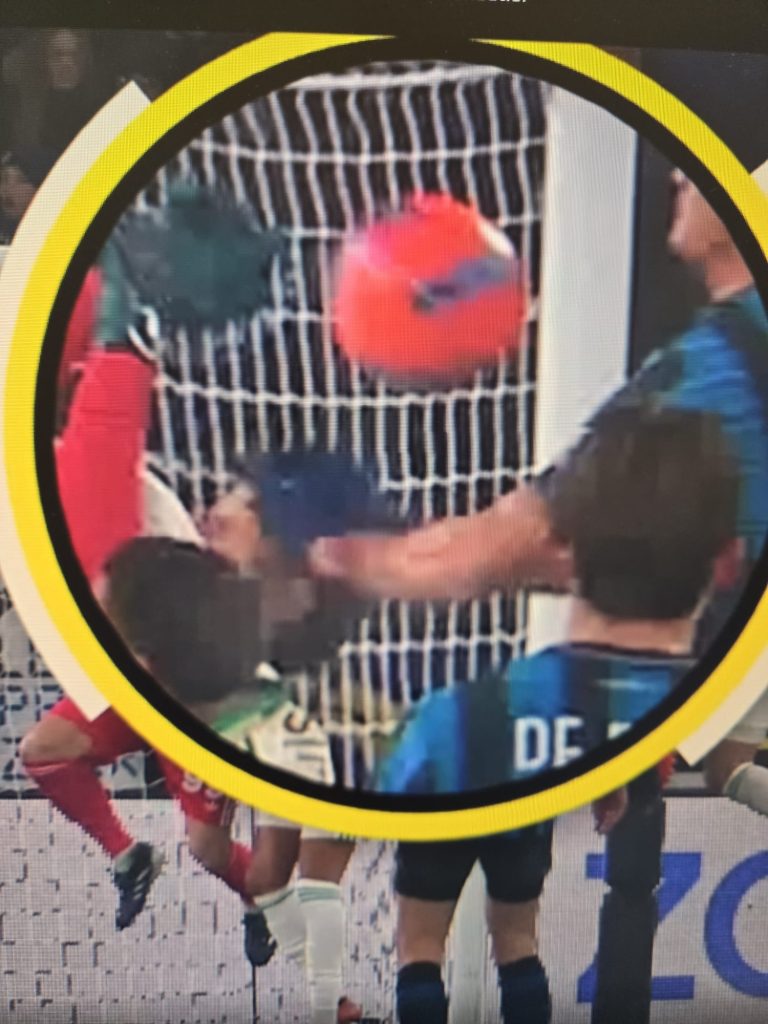
Even with regard to the handball by Scalvini, on which the VAR analysis focused, the decision not to deem the (clear) touch by the Atalanta player punishable must also be considered incorrect. Any contact with the arm inside the attacking penalty area that occurs immediately before a goal is, in fact, to be considered an offence, with the consequent disallowing of the goal.
The footage shows that, after a deflection, the ball strikes Scalvini’s arm, and that he also deliberately pushes his shoulder forward to “guide” the ball toward the goal. The contact occurs below the shoulder and, under the Laws of the Game, any touch from the hand (included) up to the shoulder is to be considered handball (or armball).
For this reason, in the case of Scalvini’s goal there are two distinct infringements to be noted — the foul on the goalkeeper and the subsequent arm contact — both of which should have led to the disallowing of Atalanta’s goal.