Roma–Lille – On Matchday 2 of the Europa League, we already get a key clash between two clubs considered among the favorites for the trophy.
On one side, Gasperini’s Roma, and on the other, Genesio’s Lille. Both sides come off narrow wins in their openers: the Giallorossi defeated another French side, Nice, with goals from N’Dicka and Mancini, while Les Dogues edged Norwegian side Brann thanks to strikes from Igamane and Giroud.
Roma changed managers this season but still relies on a core of experienced players such as Mancini, N’Dicka, Hermoso, Angelino, and Cristante. Lille, by contrast, leans heavily on young talent—Bouaddi, Fernandez-Pardo, and Ngoy above all—while Giroud serves as the veteran leader on the pitch.
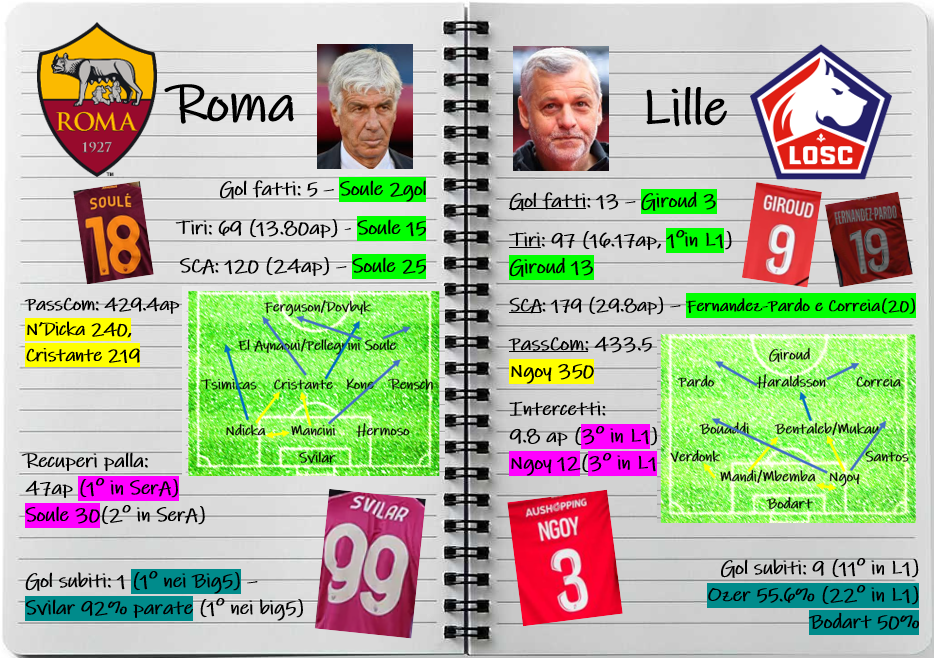
Domestic form – In Serie A, Gasperini’s Roma sits joint top with Napoli and Milan after 4 wins in 5 matches, thanks in part to the best defense across Europe’s big five leagues, with just one goal conceded. Lille, after six Ligue 1 rounds, is sixth following two consecutive defeats without scoring. Still, they have the second-best attack in France with 13 goals, behind only Monaco (14)—a number clearly boosted by their 7–1 thrashing of Lorient a few weeks ago.
Build-up play – The formations immediately reveal two teams with different ideas, yet with some similarities. In the build-up, both rely on their center-backs supported by midfielders—and in Lille’s case, also the full-backs. Neither coach, however, looks to invite pressure with an elaborate build-up from the back. Instead, both aim to move the team up quickly, often looking wide. For Roma, the play flows through Mancini and N’Dicka with Cristante dropping to help. For Lille, the pivot is Ngoy, supported by teammates alternating as left center-back or holding midfielder (Mandi or Mbemba at the back, Makau, Bentaleb, and Bouaddi in midfield).
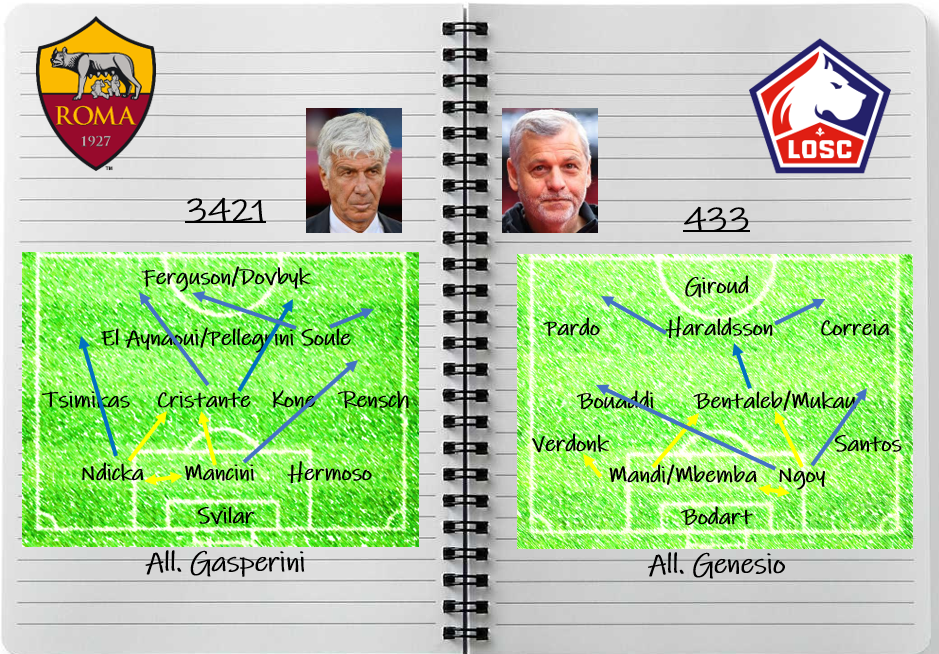
Final third play – For Roma, Soule acts both as offensive playmaker—often dropping to support the build-up—and as the player tasked with breaking down defenses thanks to his skills in tight spaces. He is often helped by Kone, who acts as a pendulum, linking phases across the pitch. The setup then varies depending on who starts as the left-sided trequartista. For Lille, Haraldsson is the offensive director, distributing passes to wide men Fernandez-Pardo and Felix Correia, who exploit their pace to either hit the byline or cut inside for a shot.
Attacking phase – Roma has struggled to produce consistently in attack so far (9th in Serie A with 5 goals in 5 matches, and only 7th for shots attempted). Their play is effective in the attacking third up to the edge of the box, where they record excellent numbers for possession and density (best Field Tilt in Serie A) and keep a high defensive line. But their efficiency collapses inside the area: just 5th in Serie A for touches in the opposition box. The numbers show a team that tries to beat their man but with very poor results (32.2% dribble success, second-worst in the league ahead of only Lecce). Soule remains Roma’s main certainty: top scorer with 2 goals, most shots taken (16, 6 on target), and most shot-creating actions (27).
The data tells the opposite story for Lille: the second-best attack in Ligue 1 with 13 goals in 6 games, first in the league for shots attempted (97). They also top the league in touches inside the opposition box, arriving quickly and in numbers, which makes them highly dangerous (1st in Ligue 1 for xG). Fernandez-Pardo and Giroud are the main references here, but Correia is also a threat.
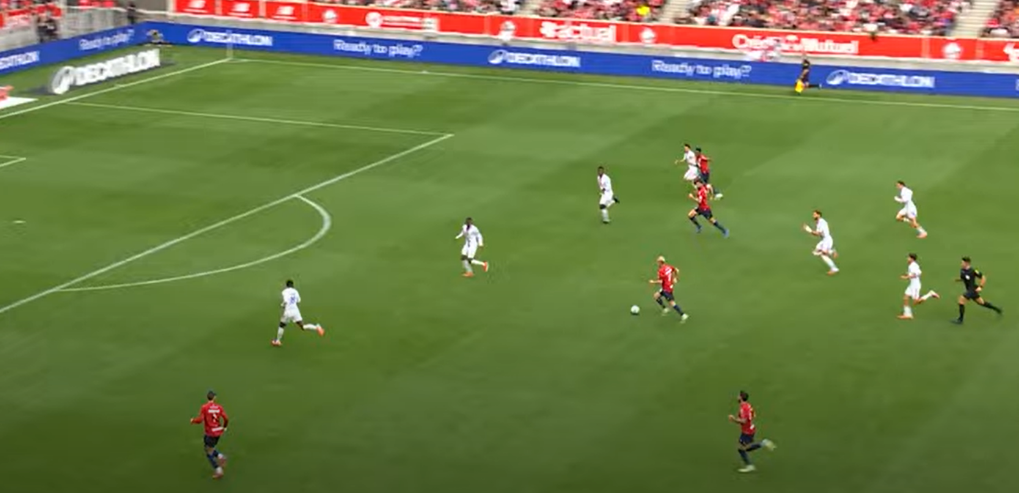
Haraldsson acts as the offensive playmaker
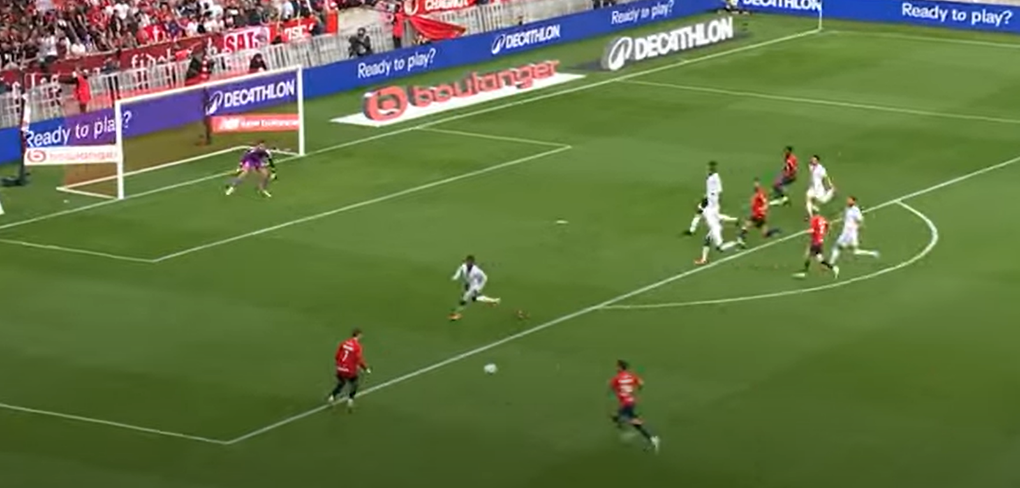
Fernandez-Pardo receives the ball and uses his unpredictability
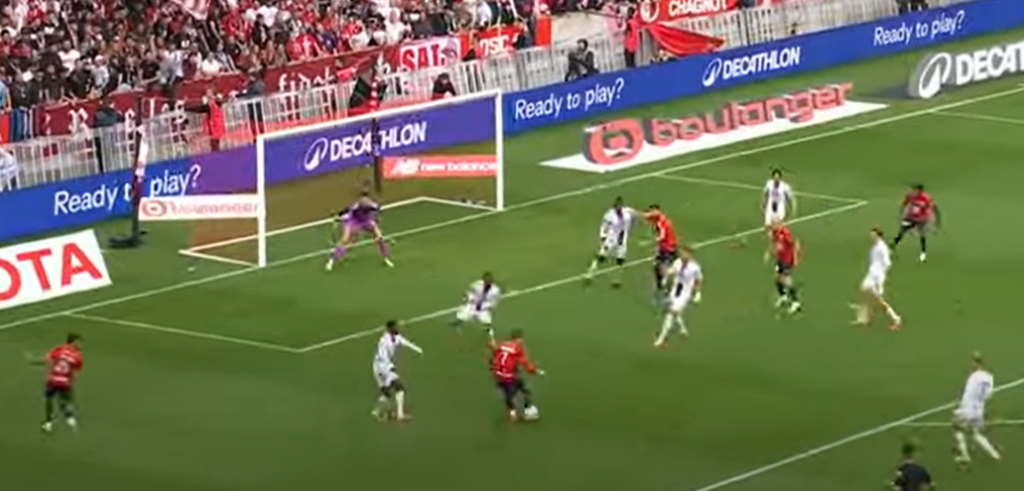
Five players in the box make life difficult for defenders
Defensive phase – If Roma struggles to get into the opponent’s box, it’s equally true that opponents struggle to get into theirs. The Giallorossi have allowed the fewest touches in their own penalty area in Serie A (just 55), and also the fewest in their defensive third overall (422). Gasperini doesn’t allow teams to approach Roma’s area, pressing high with great effectiveness. The numbers are remarkable: best PPDA in Europe’s big five leagues (just 6.66 passes allowed per defensive action) and 235 loose-ball recoveries (1st in Serie A, 4th in the big five). In individual duels, Roma’s numbers are more modest, with Kone, Mancini, and N’Dicka among the best.
Lille, on the other hand, struggles defensively: 9 goals conceded in 6 games, ranking only 11th in Ligue 1. Like Roma, they look to keep a high line and press aggressively. Both teams average a defensive line above 50 meters, forcing opponents under 43 meters on average, but Roma clearly executes more effectively. The French side also allows few touches and shots, but those chances are often dangerous: 10th in Ligue 1 for xG conceded. Defensive errors have made matters worse, leading to high-risk opportunities for opponents. Their pressing is based more on individual duels than collective recoveries, and they rank 4th in France for interceptions, with Ngoy and Bouaddi leading in this department.
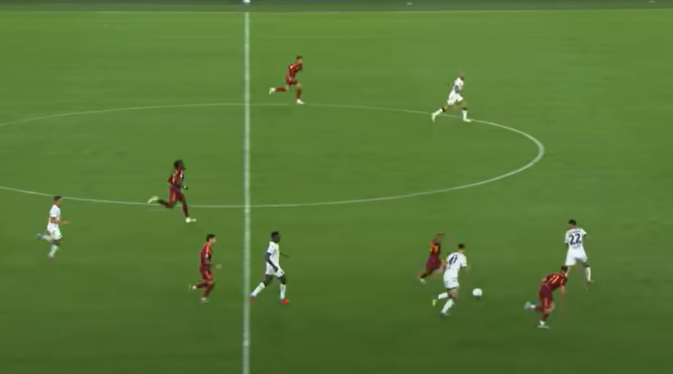
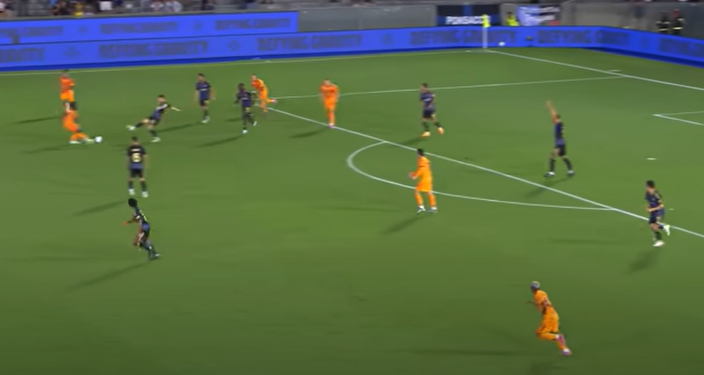
Two sequences where Roma wins back possession and, with just a few passes, creates a shot
Goalkeepers – One of Roma’s most important players has been the man between the posts. Mile Svilar has the highest save percentage across Europe’s top five leagues (92%) and 2.6 post-shot xG prevented out of 3.6 expected. In practical terms, Roma should have conceded 4 goals in Serie A, but he has saved them 3. Lille’s numbers are less reassuring: Ozer had shown decent metrics for goals prevented earlier in the season but had a poor save rate (55%). He has since been injured, so Bodert will start. He comes off a good season in Ligue 2 with Metz, but he does not provide the same level of security as his Turkish teammate.