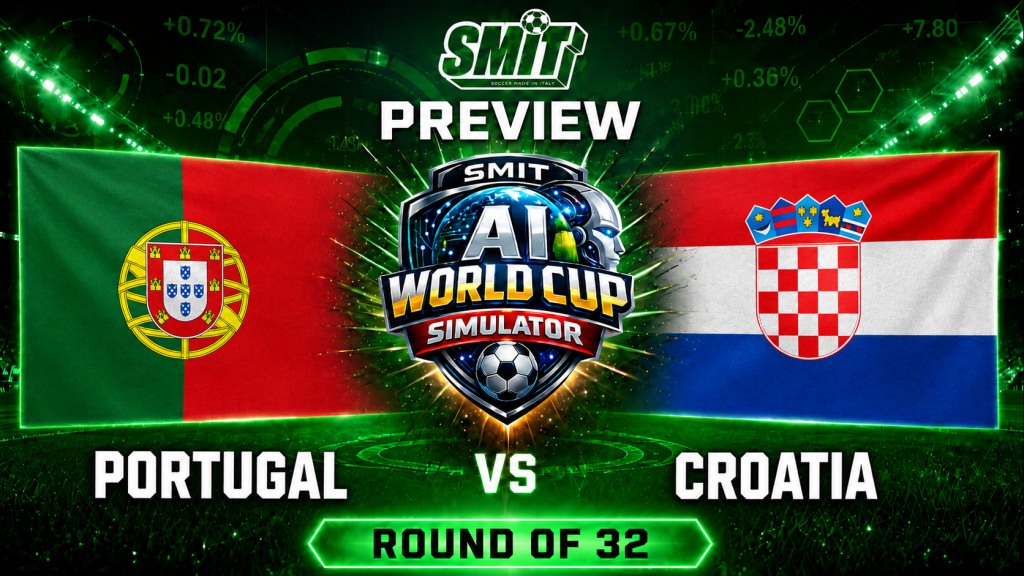
Portugal and Croatia meet in Toronto in one of the most emotionally loaded matchups of the World Cup 2026 Round of 32. Cristiano Ronaldo and Luka Modrić may be facing one last knockout night on the world stage, but this is more than nostalgia. Portugal arrive unbeaten and packed with attacking depth. Croatia arrive with the tournament DNA of a team that has made deep World Cup runs a habit.
The Big Picture
Portugal vs Croatia feels like a meeting between two eras that refuse to end.
For Portugal, the group stage was steady but not fully convincing. Roberto Martínez’s side opened with a 1-1 draw against DR Congo, delivered its best performance in a 5-0 win over Uzbekistan, then closed with a 0-0 draw against Colombia. Five points were enough to reach the knockout stage, but not enough to remove questions about attacking rhythm, game control and whether the team is getting the best out of one of the deepest squads in the tournament.
Cristiano Ronaldo remains the headline. At 41, he has played heavy minutes, scored twice and continues to carry symbolic weight for a Portugal team still chasing its first World Cup title. Martínez has defended his role, insisting decisions are made around performance and team needs, not age or external debate.
Croatia arrive from a more turbulent but familiar path. Zlatko Dalić’s team lost 4-2 to England in its opener, then responded with a 1-0 win over Panama and a 2-1 win over Ghana. That is the Croatia pattern: rarely smooth, almost always resilient. With Modrić still organizing midfield at 40, Perišić still delivering tournament experience and Gvardiol entering his prime, the Vatreni remain a dangerous knockout opponent.
Toronto adds another layer. Reuters reported that this will be Toronto Stadium’s final match of the tournament, with Ronaldo and Modrić potentially playing for one last World Cup chapter in an intimate, high-pressure environment.
The winner will face Spain in the Round of 16. That makes this not only a heavyweight European knockout match, but also the gateway to an even bigger test.
Recent Form
Portugal’s recent form is unbeaten, efficient and defensively strong.
Across the last five matches provided, Portugal have three wins and two draws, with 10 goals scored and three conceded. The World Cup group-stage sample, which carries 70 percent of the SMIT knockout-stage form model, shows a team with control but inconsistent attacking sharpness: 1-1 against DR Congo, 5-0 against Uzbekistan and 0-0 against Colombia.
The defensive profile is the major positive. Portugal conceded only once in the group stage and kept clean sheets in the last two matches. Rúben Dias, Renato Veiga, João Cancelo, Nuno Mendes and Diogo Costa give Martínez a strong base, while João Neves and Vitinha help protect the central lane through possession and counter-pressing.
The attacking numbers are more difficult to interpret. The 5-0 win over Uzbekistan showed Portugal’s ceiling, but the draws against DR Congo and Colombia exposed issues in breaking down compact or physically aggressive opponents. Portugal have elite creators in Bruno Fernandes, João Félix, Pedro Neto and Bernardo Silva, plus the bench power of Rafael Leão, Gonçalo Ramos, Francisco Conceição and others. The question is whether Martínez can turn that talent into sustained pressure.
Croatia’s form is less clean but increasingly competitive.
Across the last five matches provided, Croatia have three wins and two losses, with seven goals scored and eight conceded. The group-stage sample shows a clear recovery arc. The 4-2 loss to England exposed Croatia’s defensive vulnerability against speed and direct attacking movement. The 1-0 win over Panama restored control. The 2-1 win over Ghana showed character under pressure.
Croatia’s defensive record is the concern. Eight goals conceded in the last five listed matches and four against England reveal a team that can be stretched by pace. Portugal have exactly the wide talent to test that weakness through Neto, Félix, Cancelo and Mendes.
But Croatia’s tournament history matters because this team rarely fades emotionally. Modrić and Kovačić can slow the tempo, Perišić can still deliver decisive wide moments, and Budimir gives Dalić a penalty-box reference. If Croatia can keep the match level deep into the second half, the psychological balance could shift.
The SMIT model gives Portugal the stronger overall form score, mainly because of defensive stability and unbeaten results. Croatia remain dangerous because of experience, midfield intelligence and knockout resilience.
Tactical Keys
Portugal are expected to play in a 4-2-3-1.
Diogo Costa should start in goal, with João Cancelo, Rúben Dias, Renato Veiga and Nuno Mendes across the back line. Vitinha and João Neves are projected as the double pivot, with Pedro Neto, Bruno Fernandes and João Félix supporting Cristiano Ronaldo.
Portugal’s key tactical question is tempo. When Vitinha and João Neves move the ball quickly, Portugal can create overloads and isolate wide defenders. When circulation becomes slow, opponents can compress the middle and force Ronaldo to receive with limited service.
Bruno Fernandes is the connector. He must find the spaces behind Croatia’s midfield without leaving Portugal exposed in transition. Neto’s pace on the right can attack Gvardiol or the space outside him, while João Félix’s movement from the left can pull Croatia’s defensive block out of shape.
Ronaldo’s role is also central. He may not press like a younger forward, but he still changes box defending. Croatia must track his movement on crosses, second balls and set pieces. Portugal’s wide delivery could become a decisive weapon.
Croatia are also expected in a 4-2-3-1, though Dalić’s structure often shifts depending on the game state.
Dominik Livaković should start in goal, with Josip Stanišić, Josip Šutalo, Marin Pongračić and Joško Gvardiol in defense. Luka Modrić and Mateo Kovačić are the midfield brain, with Petar Sučić, Nikola Vlašić and Ivan Perišić supporting Ante Budimir.
Croatia’s priority is rhythm management. They cannot turn this into a wide-open game against Portugal’s pace and attacking depth. Modrić and Kovačić must slow the match when needed, draw pressure, and force Portugal into longer defensive phases.
The key for Croatia is transition protection. If Gvardiol or Stanišić push high and Portugal win the ball, Neto and Félix can attack open grass. Dalić will need compact distances between midfield and defense, especially when Bruno Fernandes receives in the half-spaces.
Set pieces could matter on both sides. Ronaldo, Dias and Veiga give Portugal aerial threat. Budimir, Pongračić, Šutalo and Gvardiol give Croatia size and delivery options.
Team News
Portugal have no confirmed injuries or suspensions listed in the provided material or in the latest available preview data. Goal’s team-news section also reports no injuries or suspensions listed for Portugal ahead of the fixture.
Martínez is expected to start Diogo Costa in goal, with Cancelo, Dias, Veiga and Mendes in defense. Vitinha and João Neves should anchor midfield, while Bruno Fernandes operates as the main playmaker. Pedro Neto and João Félix are projected wide, with Ronaldo leading the line.
There is competition in wide areas. Sports Mole notes that Neto’s place has come under pressure after a quiet outing against Colombia, with Francisco Conceição pushing for minutes. Rafael Leão and Gonçalo Ramos also give Portugal major attacking options if Martínez wants more pace or a different center-forward profile.
Croatia also have no confirmed absences listed at this stage. Goal reports no injuries or suspensions currently listed for Dalić’s side.
The projected Croatian lineup has Livaković in goal; Stanišić, Šutalo, Pongračić and Gvardiol in defense; Modrić and Kovačić in midfield; Sučić, Vlašić and Perišić behind Budimir.
Modrić remains the emotional and tactical reference point. Reuters noted that Toronto recently witnessed an emotional tribute to Modrić for his 200th international appearance, adding another layer to what could be his final World Cup knockout match.
Key Battles
Cristiano Ronaldo vs Joško Gvardiol
Ronaldo’s movement inside the box remains elite. Gvardiol must manage the duel without being pulled too far out of position. If Ronaldo pins Croatia’s center backs, Portugal’s wide players can attack second balls and cutbacks. If Gvardiol controls the space early, Croatia can limit Portugal’s highest-value chances.
Bruno Fernandes vs Luka Modrić
This is a battle of creative control. Bruno wants verticality, early passes and final-third pressure. Modrić wants rhythm, patience and control of tempo. If Bruno finds space between Croatia’s lines, Portugal can accelerate. If Modrić slows the match and denies transition chaos, Croatia can pull Portugal into a more familiar knockout rhythm.
Vitinha vs Mateo Kovačić
Vitinha gives Portugal press resistance and technical control. Kovačić gives Croatia ball-carrying and escape routes under pressure. The team that wins this duel will likely control the match’s middle third.
Pedro Neto vs Joško Gvardiol and Ivan Perišić
Neto’s pace is one of Portugal’s clearest weapons. Croatia’s left side must manage him carefully, especially if Perišić pushes forward. If Neto gets repeated isolation, Portugal can create danger quickly. If Croatia force him backward, Portugal may need more creativity from Félix and Fernandes.
Nuno Mendes vs Petar Sučić
Mendes can dominate territory on Portugal’s left, but Sučić’s energy and timing can make that side uncomfortable. If Mendes pushes too high, Croatia can target the space behind him. If Mendes pins Croatia back, Portugal gain a major outlet.
Ante Budimir vs Rúben Dias
Budimir gives Croatia a physical reference and aerial threat. Dias must control first contacts and prevent Budimir from laying balls into Vlašić, Perišić or Modrić. This duel will matter especially if Croatia spend long stretches defending and need a direct escape route.
What’s at Stake
This Round of 32 match carries enormous symbolic weight.
For Portugal, it is another step in the search for a first World Cup title. The squad is deep enough to compete with anyone, but the window around Ronaldo’s final tournament years is closing. A loss here would be seen as a major missed opportunity for one of the most talented Portuguese teams ever assembled.
For Croatia, this is another chance to prove that its World Cup identity is not built on population size or prediction models, but on mentality, midfield intelligence and survival under pressure. After finishing runner-up in 2018 and third in 2022, Croatia still believes it can extend the Modrić era one more time.
The winner will face Spain in the Round of 16. Spain advanced after beating Austria, which means the next round could deliver either an Iberian classic between Spain and Portugal or a technical European battle between Spain and Croatia.
For Ronaldo and Modrić, this may also be personal. One of them could be playing his final World Cup match in Toronto.
Probable Lineups
Portugal Probable Lineup
Formation: 4-2-3-1
Diogo Costa; João Cancelo, Rúben Dias, Renato Veiga, Nuno Mendes; Vitinha, João Neves; Pedro Neto, Bruno Fernandes, João Félix; Cristiano Ronaldo.
Croatia Probable Lineup
Formation: 4-2-3-1
Dominik Livaković; Josip Stanišić, Josip Šutalo, Marin Pongračić, Joško Gvardiol; Luka Modrić, Mateo Kovačić; Petar Sučić, Nikola Vlašić, Ivan Perišić; Ante Budimir.
SMIT AI WORLD CUP SIMULATOR
Squad Strength Index
| Team | Goalkeeping | Defense | Midfield | Attack | Depth | Total |
|---|---|---|---|---|---|---|
| Portugal | 8.5 | 8.7 | 8.9 | 8.8 | 9.0 | 87.8 |
| Croatia | 8.0 | 8.1 | 8.6 | 7.7 | 7.8 | 80.4 |
Portugal score higher because of squad depth, attacking variety, defensive balance and a younger, more explosive supporting cast around Ronaldo. Croatia score strongly in midfield intelligence and goalkeeper reliability, but defensive vulnerability against speed lowers the total.
Expected Goals Simulation
| Team | Projected xG | Shot Quality Trend | Defensive Risk | Set-Piece Threat |
| Portugal | 1.68 | High | Low-to-medium | High |
| Croatia | 1.08 | Medium | Medium-high | Medium-high |
The simulation projects Portugal to create the higher-value chances through wide overloads, Bruno Fernandes’ final ball and Ronaldo’s penalty-box movement. Croatia’s xG comes mainly from controlled possession phases, set pieces and Budimir’s aerial presence.
Win Probability
| Outcome | Probability |
| Portugal win in 90 minutes | 51% |
| Draw after 90 minutes | 29% |
| Croatia win in 90 minutes | 20% |
| Portugal advance overall | 65% |
| Croatia advance overall | 35% |
Portugal are favored, but the draw-after-90 probability is significant because Croatia are one of the most experienced knockout teams in the tournament. The simulator gives Portugal the overall edge because of depth, defensive form and wide attacking quality.
Four Most Likely Results
| Result | Probability |
| Portugal 2-1 Croatia | 18% |
| Portugal 1-0 Croatia | 15% |
| Portugal 1-1 Croatia, Portugal advance after extra time | 13% |
| Portugal 2-0 Croatia | 11% |
Most Likely Result
Portugal 2-1 Croatia
The SMIT AI Simulator predicts Portugal to advance to the Round of 16 with a narrow 2-1 win after 90 minutes.
Predicted Goalscorers
Portugal: Cristiano Ronaldo, Bruno Fernandes
Croatia: Ivan Perišić
Player of the Simulation
Bruno Fernandes, Portugal
Bruno Fernandes is projected as the decisive player because of his chance creation, set-piece delivery and ability to find the final pass in a match where Croatia will try to slow the tempo.
Confidence Level
Medium
Portugal have the stronger squad and better defensive numbers, but Croatia’s knockout pedigree, midfield control and emotional resilience make this a dangerous matchup. The simulator sees Portugal as the better-positioned team, not a runaway favorite.
AI Match Simulation
The simulation begins with Portugal trying to take territorial control through Vitinha and João Neves. Croatia do not press recklessly. Dalić’s team sits in a compact shape, allowing Portugal possession in safe zones while protecting the central spaces around Modrić, Kovačić and the back four.
Portugal’s first threat comes from the right. Cancelo combines with Pedro Neto, who accelerates into space and delivers early toward Ronaldo. Gvardiol reads the danger and clears, but the pattern gives Croatia an immediate warning: Portugal will attack the wide lanes whenever possible.
Croatia respond by slowing the match. Modrić drops deep, Kovačić carries through midfield, and Perišić starts drifting into pockets on the left. The Vatreni do not create many early chances, but they reduce Portugal’s rhythm and turn the first half into a tactical battle.
The opening goal comes from a Portugal set-piece. Bruno Fernandes delivers from the right, Ronaldo separates from his marker and heads low past Livaković. Portugal lead 1-0, and the match begins to open.
Croatia’s response is calm. Modrić and Kovačić take more responsibility in possession, and Perišić becomes the outlet. Late in the first half, Croatia find the equalizer. Gvardiol advances on the left, combines with Perišić, and the veteran winger attacks the back post to finish a cross from the opposite side.
At 1-1, the second half becomes tense. Portugal have more attacking options, but Croatia are comfortable living in a close game. Martínez turns to the bench for more speed, while Dalić tries to keep Modrić and Kovačić connected to the ball.
The decisive moment arrives in the final 20 minutes. Vitinha breaks pressure in midfield and finds Bruno Fernandes between the lines. Bruno takes one touch, recognizes Ronaldo pulling defenders toward the box, and instead drives a low finish into the corner from the edge of the area.
Croatia push late, sending Budimir into aerial duels and asking Perišić and Vlašić to attack second balls. Portugal defend deeper in stoppage time, with Dias winning key headers and Diogo Costa controlling the box.
According to the SMIT AI Simulator, Portugal advance with a 2-1 win — a tight, emotional knockout match decided by set-piece quality, Bruno Fernandes’ final-third influence and Portugal’s deeper attacking options.
Why the Simulator Predicts This Result
The simulation gives Portugal the edge for five main reasons.
First, Portugal’s defensive profile is stronger. They conceded only once in the group stage and have kept back-to-back clean sheets. Croatia, by contrast, conceded four against England and eight across the last five listed matches.
Second, Portugal have more attacking variety. Ronaldo remains the central reference, but Bruno Fernandes, João Félix, Pedro Neto, Cancelo, Mendes and multiple bench options give Martínez several ways to create chances.
Third, Croatia’s midfield can control tempo, but Portugal have enough press resistance to avoid being trapped. Vitinha and João Neves help Portugal play through pressure, while Bruno Fernandes can attack the gaps once Croatia’s midfield line shifts.
Fourth, wide speed favors Portugal. Croatia’s experience is a strength, but against direct runners and overlapping fullbacks, the defensive line can be stretched. That was visible in the England match and remains a concern here.
Fifth, Portugal’s bench gives them the late-game advantage. Leão, Ramos, Bernardo Silva, Francisco Conceição and Gonçalo Ramos can all change the rhythm if the match becomes stuck. Croatia’s bench is useful, but Portugal’s attacking depth is one of the best in the tournament.
The SMIT AI Simulator does not discount Croatia’s knockout DNA. The Vatreni are built to survive, slow games down and make favorites uncomfortable. But over 90 minutes, Portugal’s defensive stability, attacking depth and Bruno Fernandes’ creative edge produce the narrow winning margin.