From artificial turf to freezing temperatures — and a familiar face from Serie A — Inter’s Champions League playoff begins in one of Europe’s toughest environments.
On paper, Inter’s Champions League playoff against Bodø/Glimt might look like a favorable draw. In reality, it could be one of the most uncomfortable trips of the European season.
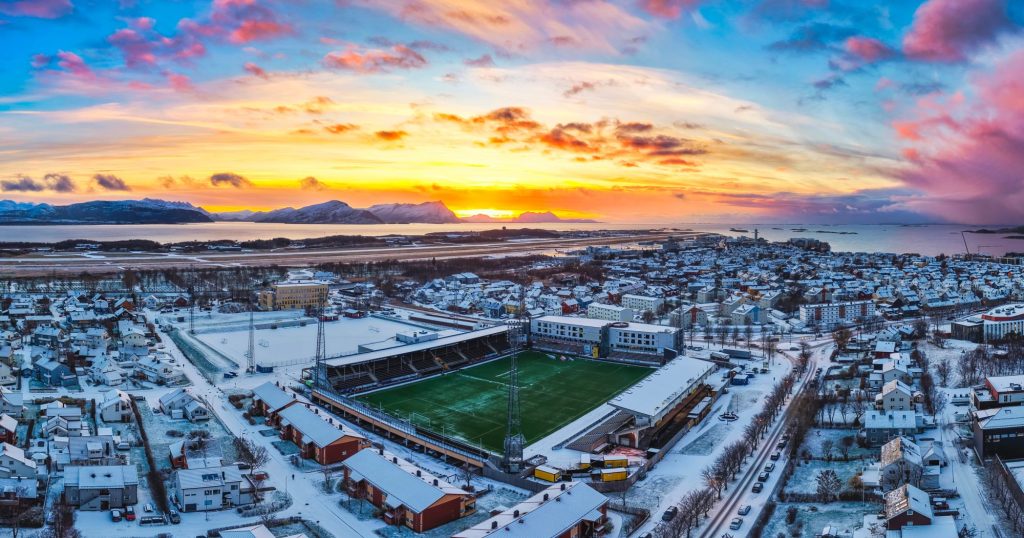
Bodø lies just north of the Arctic Circle, and in February, football there is played under conditions that feel closer to an expedition than a matchday. The first leg will take place at Aspmyra Stadion, on artificial turf and in sub-zero temperatures — two factors that have repeatedly turned Bodø/Glimt’s home games into nightmares for visiting teams.
But climate alone doesn’t explain why Inter should be cautious.
Despite finishing 23rd in the league phase, the Norwegian champions have built a reputation as giant killers. They have already beaten Manchester City, taken points from Borussia Dortmund, and — most impressively — won away at Atletico Madrid. This is not a team that only thrives at home.
The symbol of Bodø/Glimt’s rise is a familiar name for Serie A fans: Jens Petter Hauge. Once a Milan player, the Norwegian winger has reinvented himself back home. With four goals in this Champions League campaign, Hauge brings speed, directness, and constant one-on-one threat — exactly the kind of profile that can punish teams struggling to adapt to unusual conditions.
Everything at Bodø/Glimt is built around continuity. Head coach Kjetil Knutsen has been in charge since 2018, guiding the club to four league titles in five seasons and transforming them into a stable European presence. His teams press high, attack vertically, and play without fear — regardless of the opponent’s pedigree.
There is also an unusual rhythm advantage. Bodø/Glimt’s domestic season ended in November and restarts in March, meaning the squad has spent months preparing almost exclusively for Champions League fixtures. Fewer matches, fewer distractions — and total focus on Europe.
For Inter, the challenge will go beyond tactics. Adaptation will be crucial: to the pitch, to the cold, to the tempo of a team that turns environmental extremes into competitive weapons.
Inter remain favorites over two legs, but the first 90 minutes in Norway are a trap waiting to snap shut. History suggests that anyone who treats Bodø/Glimt as a minor obstacle usually learns the lesson the hard way.