
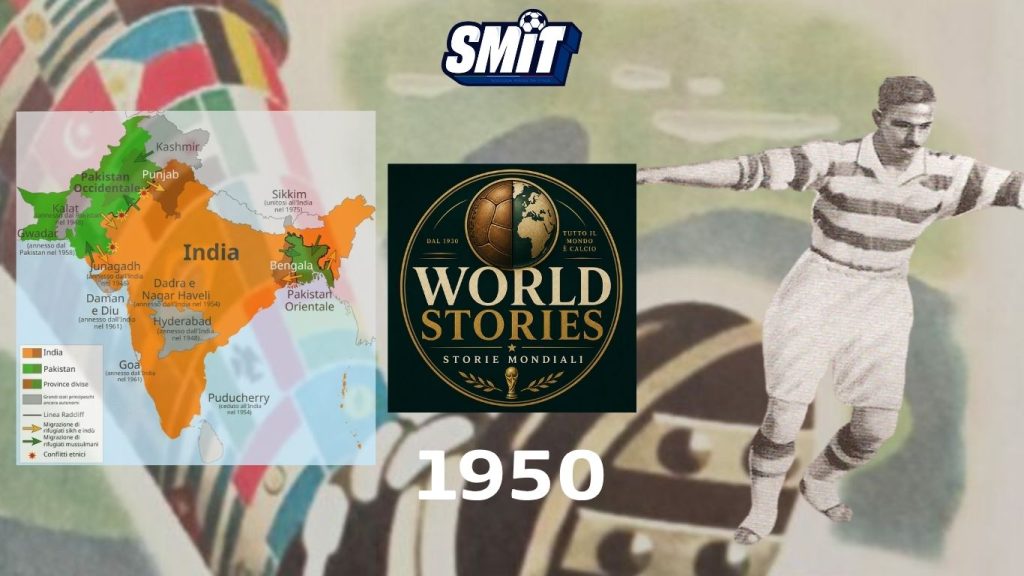
Qualified for the 1950 World Cup without playing a match, India walked away from football’s biggest stage over a dispute that became part of the sport’s folklore
The 1950 World Cup in Brazil was unlike any other.
It was the first tournament after World War II and remains the only World Cup not to feature a traditional final. Instead, the champion was decided through a final round-robin group involving Brazil, Uruguay, Spain and Sweden.
Everything seemed set for a Brazilian triumph.
Heading into the last match, Brazil had four points while Uruguay had three. The hosts only needed a draw in front of nearly 170,000 spectators at the Maracanã Stadium.
Instead, Uruguay stunned the football world with a 2-1 victory, silencing an entire nation in what is still remembered today as the “Maracanazo,” one of the greatest upsets in sporting history.
While Brazil mourned, another fascinating story unfolded before the tournament had even begun.
It involved India.
The reigning world champions, Italy, were surprisingly eliminated in the first round. Their group contained only three teams: Italy, Paraguay and Sweden.
Every other group had four nations.
Why was one team missing?
Because India never showed up.
They were not the only country to withdraw. Scotland refused to travel after finishing behind England in qualifying, while other nations, including Austria, struggled with the financial burden of crossing the Atlantic by ship.
India’s qualification itself had been extraordinary.
Placed in an Asian qualifying group alongside Burma, the Philippines and Thailand, India advanced without playing a single match because all three opponents withdrew.
As a result, India earned a place at the World Cup by default.
At the time, many in international football were eager to welcome the emerging Asian nation. Just two years earlier, at the 1948 Olympic Games in London, India had impressed observers with a spirited performance in a narrow 2-1 defeat against France.
The country had also recently gained independence from Britain after decades of colonial rule.
The political backdrop was complex. The partition of British India had created two new nations, India and Pakistan, triggering a conflict whose consequences are still felt today. The assassination of Mahatma Gandhi in 1948 had further shaken the young nation.
Against this backdrop, India’s participation in the World Cup carried significance beyond football.
Yet the team never boarded the ship to Brazil.
The reason has become one of the most famous stories in World Cup history.
Many Indian players preferred playing barefoot.
At the 1948 Olympics, several members of the national team had competed without boots, believing football was more natural and expressive when played with bare feet. For them, it was part of their sporting identity.
When preparations began for the 1950 World Cup, the players requested permission to continue playing barefoot.
FIFA refused.
The governing body insisted that all participants wear proper football boots, as required by the rules of the competition.
India asked for an exemption but received none.
As the story has been told for decades, the refusal became symbolic. Many players viewed the decision as another example of European authorities imposing their rules on a newly independent nation.
For them, playing barefoot represented more than a footballing preference.
It represented freedom.
And so India withdrew from the World Cup.
The nation that had qualified without kicking a ball would never get the chance to play on football’s biggest stage.
More than seventy years later, the image of a team choosing principle over participation remains one of the most unusual and debated stories in World Cup history.
It is the story of a World Cup that India reached—but never played.
World Stories is a series that uncovers the most incredible, forgotten, and controversial stories from the history of the FIFA World Cup.