
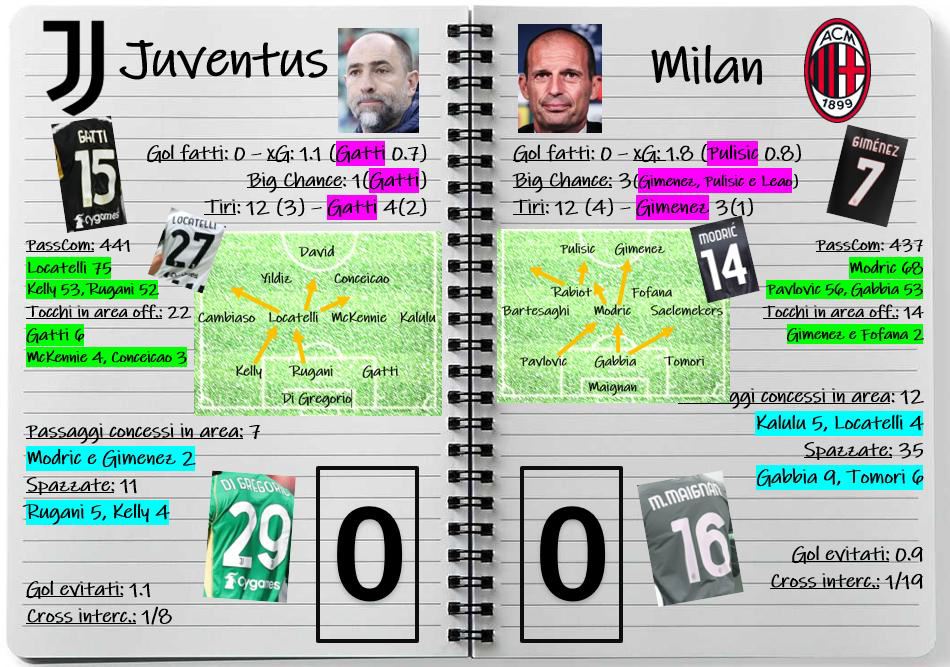
Tudor vs Allegri – Juventus vs Milan closed out Serie A’s sixth matchday in an unspectacular way, yet consistent with the approaches of the two coaches. Both Tudor and Allegri focus on strong defensive solidity, though their systems are structured a bit differently — and those two “ideologies” were clearly visible throughout the match.
Defensive phases – Both teams rely on heavy compactness when out of possession, with a back three supported by the wing-backs that turns into a line of five. Tudor’s Juve, however, tends to be slightly more aggressive, pressing higher up the pitch, while Allegri approached the game at the Stadium with a much more positional defensive setup. Once Juve broke Milan’s first pressing line — which wasn’t particularly intense — the Rossoneri dropped deep, packing the box and forcing the Bianconeri into long, patient spells of possession that often led to little end product. Milan rank third in Serie A for passes allowed to opponents in their own defensive third — only Pisa and Verona have allowed more. One stat that highlights Milan’s sit-and-wait approach is the number of crosses conceded: 19 (one intercepted by Maignan) compared to just 8 conceded by Juve (one intercepted by Di Gregorio).
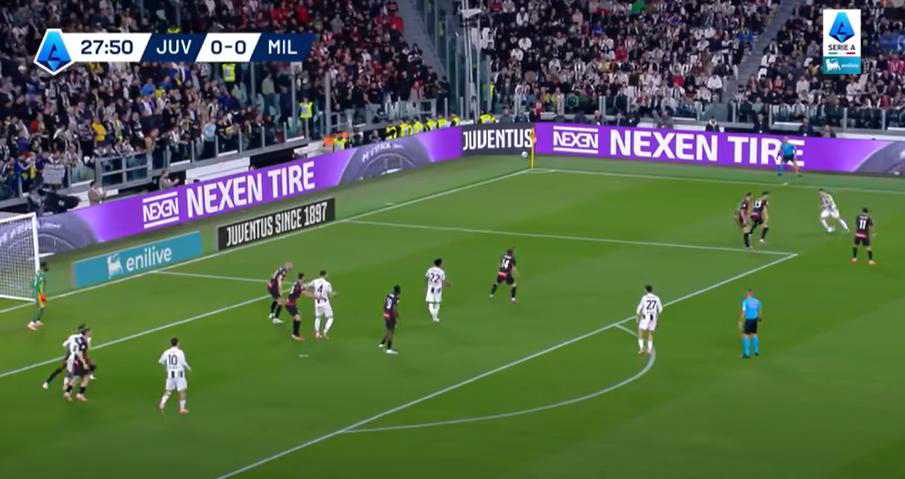
Nine men defending Milan’s box
Juve’s possession phase – Tudor is used to flipping the play quickly through fast transitions, but Milan didn’t allow that this time. Juve completed as many as 12 passes inside Milan’s box but without creating any real breakthroughs. Despite a large amount of offensive build-up, Juve managed only 12 shots (their second-worst tally of the season), with just 3 on target (two by Gatti and one by Cambiaso — their worst mark of the year) and only one big chance (Gatti early in the second half). Locatelli dictated the tempo, completing the most passes of anyone on the pitch (75), many of them (16) aimed at pushing the team higher toward the attacking third. Even so, none of Juve’s forwards managed to find gaps between Milan’s defensive lines. Conceição was slightly more incisive, managing a few individual plays. The mediocre performance of Juve’s attackers is clear in the numbers: the players with the most touches inside the opponent’s box were Gatti and McKennie, and Gatti also took the most shots (4 total), compared to just one from Openda — the only attempt by any of Juve’s forwards.
Milan’s possession phase – On the other side, Milan were slightly more effective at trying to impose their quick counterattacking style. Allegri’s defensive setup was built around waiting for the right moment to win the ball back and break, with the Rossoneri recording an impressive 35 clearances (a season-high, with Gabbia contributing 9). When transitioning forward, Allegri opted less for Tudor’s type of build-up, instead carrying the ball more directly — first through Modric, then Rabiot — and it all worked well up to the final third.
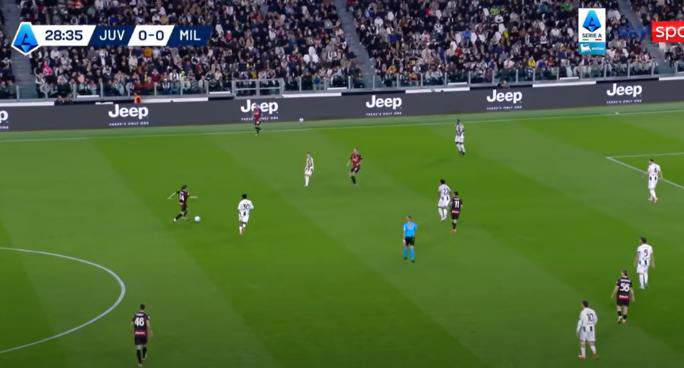
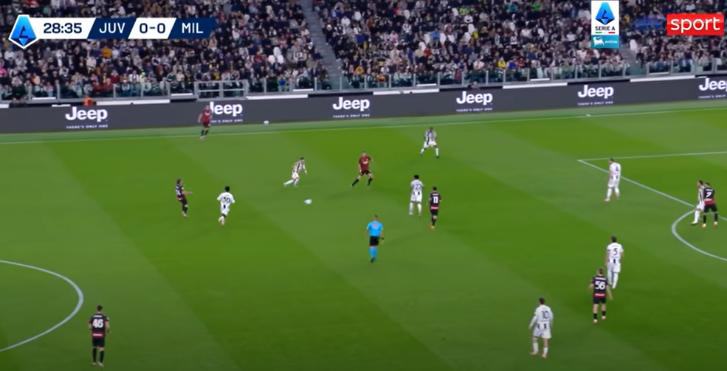
Modric carried the ball forward and laid it off to Rabiot, who advanced and took a shot from distance.
In the attacking third, Pulisic and Saelemaekers usually manage to dribble into the box and create danger, but Tudor’s defense effectively neutralized that weapon. Modric became the team’s key man, orchestrating transitions and vertical passes. The lack of dribbling incursions from Pulisic and the wide players led the Croatian to look more directly for Gimenez, who not only won a penalty but also completed two hold-up plays inside the box and produced a dangerous shot from an individual move. Thanks to that outlet, Milan still managed to create three big chances (Pulisic’s penalty, Gimenez’s solo run, and Leao’s opportunity in the 73rd minute), but only 12 shots overall (their second-worst of the season), with 4 on target.
The goalkeepers – Despite both teams’ limited offensive output, the goalkeepers proved decisive: Maignan finished with +0.9 and Di Gregorio with +1.1 in the “goals prevented” metric.
Conclusions – In the end, the two teams effectively neutralized each other, with Milan perhaps finding a few more offensive openings. The Rossoneri produced 1.8 expected goals compared to Juventus’s 1.1 — though that figure is heavily influenced by the penalty.