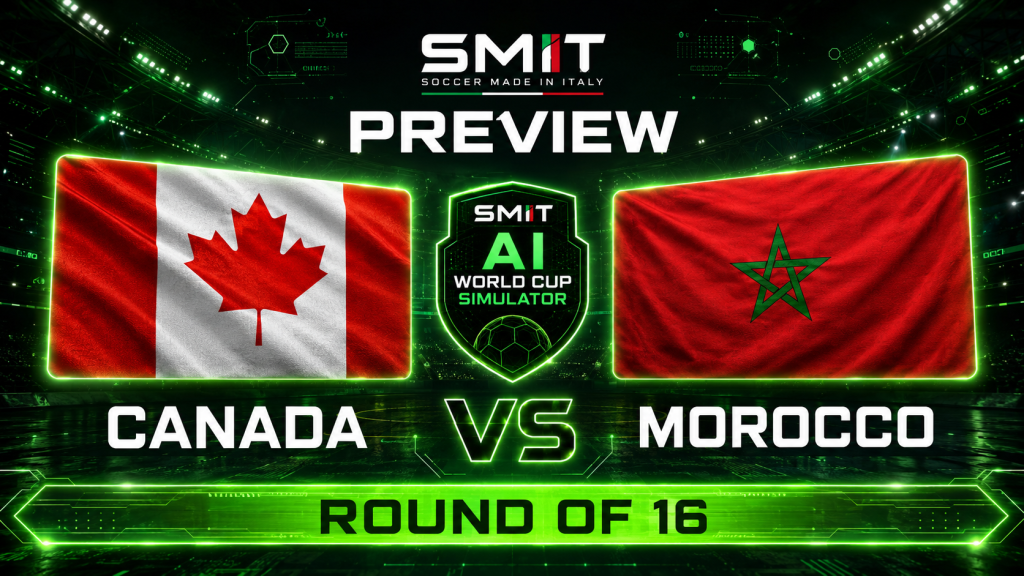
Canada and Morocco meet in Houston for a Round of 16 clash loaded with history, pressure and momentum: the co-hosts are chasing a first-ever World Cup quarterfinal, while the Atlas Lions are trying to prove their 2022 semifinal run was not a miracle, but the start of a new African powerhouse era.
The Big Picture
Canada are living the greatest tournament in their men’s national-team history. After reaching the knockout stage for the first time, Jesse Marsch’s side eliminated South Africa 1-0 in the Round of 32 thanks to Stephen Eustáquio’s stoppage-time winner. Canada Soccer quoted Eustáquio after the match saying the goal felt like a moment carried by the entire country, a perfect summary of how emotional this run has become.
Now comes the biggest test yet. Morocco arrive as one of the tournament’s most battle-tested teams, unbeaten across their last five matches and fresh from a dramatic penalty shootout win over the Netherlands. Al Jazeera lists Canada vs Morocco as a Round of 16 match at Houston Stadium on July 4, with a place in the quarterfinals on the line.
This is also a rematch with World Cup history behind it. Morocco beat Canada 2-1 in the 2022 group stage, then went on to become the first African team ever to reach a World Cup semifinal. This time, Canada are not just participants. They are co-hosts, survivors and a team that has already changed its own soccer story.
Recent Form
Canada have won two, drawn two and lost one of their last five matches, scoring 10 goals and conceding four.
The form line needs context. The 6-0 win over Qatar heavily boosted Canada’s attacking numbers, but the more important data point for this knockout preview is the last two tournament matches: a 2-1 defeat to Switzerland and a 1-0 knockout win over South Africa. Canada are no longer playing only with speed and enthusiasm; they are showing they can survive tense, low-scoring matches.
The South Africa win was especially important psychologically. Canada had to wait until stoppage time, stay compact, avoid panic and still find one decisive attacking moment. That is a major step for a national team that entered 2026 without a men’s World Cup win in its history.
Morocco have won three and drawn two of their last five, remaining unbeaten. Their World Cup run has been more demanding: 1-1 against Brazil, 1-0 over Scotland, 4-2 over Haiti, then 1-1 against the Netherlands before winning on penalties. Goal’s preview notes that Morocco’s latest result was the penalty shootout victory over the Dutch after the 1-1 draw, following wins over Haiti and Scotland and a draw with Brazil.
The Atlas Lions’ trend is clear: they can suffer, they can counter, they can score in different ways and they can handle knockout pressure. Their defensive numbers have not been perfect — they have conceded in four of the last five — but their emotional control under pressure remains elite.
Tactical Keys
Canada are expected to line up in a 4-4-2, with Maxime Crépeau in goal, Alistair Johnston, Derek Cornelius, Moïse Bombito and Richie Laryea across the back line, Tajon Buchanan, Stephen Eustáquio, Nathan Saliba and Liam Millar in midfield, and Jonathan David with Tani Oluwaseyi up front.
The key for Marsch is balance. Canada want to press, but they cannot press recklessly against Morocco. Brahim Díaz, Azzedine Ounahi, Bilal El Khannouss and Ismaël Saibari are all comfortable receiving under pressure and turning into space. Reuters reported that Marsch described Morocco as having “zero weaknesses” and emphasized that Canada must stay aggressive defensively without losing focus.
Canada’s best attacking route is vertical. David’s movement between center backs, Buchanan’s direct running and Millar’s ability to carry the ball into space can hurt Morocco if the Atlas Lions push both fullbacks high. Eustáquio’s role will be crucial: he must connect the first pass out of pressure and also protect the space in front of Canada’s back four.
Morocco are expected in a 4-2-3-1, with Yassine Bounou in goal, Achraf Hakimi, Issa Diop, Chadi Riad and Noussair Mazraoui in defense, Ayyoub Bouaddi and Neil El Aynaoui as the double pivot, and Brahim Díaz, Azzedine Ounahi and Bilal El Khannouss behind Ismaël Saibari.
Morocco’s tactical strength is controlled chaos. Reuters reported that Mohamed Ouahbi backed Brahim Díaz to create “organised chaos,” using his mobility and freedom to unsettle Canada’s defensive structure.
The Atlas Lions will likely try to overload Canada’s left side through Hakimi and Díaz, then use Ounahi and El Khannouss to combine between the lines. Saibari gives Morocco a mobile central reference rather than a classic fixed No. 9, which could pull Bombito and Cornelius into uncomfortable zones.
Canada must avoid turnovers in central areas. Morocco are at their most dangerous when the first pass after a regain finds Díaz, Ounahi or Hakimi quickly.
Team News
Canada are still managing key absences and fitness concerns.
Ismaël Koné is unavailable after the leg injury suffered against Qatar. Alphonso Davies has not played a minute in the tournament because of his injury situation, but his potential return remains a storyline around the Canadian camp. Reuters reported that Marsch cited Davies’ return as a possible boost while preparing for Morocco.
The projected XI does not include Davies, with Laryea expected at left back and Johnston on the right. Crépeau should remain in goal, while Jonathan David and Tani Oluwaseyi are expected to start together up front.
Morocco have no confirmed suspensions in the material provided. The likely XI has Bounou in goal, Hakimi and Mazraoui at fullback, Diop and Riad in central defense, Bouaddi and El Aynaoui in midfield, and Díaz, Ounahi, El Khannouss and Saibari in the attacking structure.
The key player to watch is Saibari. He has already scored three goals in the tournament and converted the decisive penalty against the Netherlands. Al Jazeera highlighted him as one of the central figures of the matchup after Morocco’s Round of 32 shootout win.
Key Battles
Jonathan David vs Chadi Riad and Issa Diop
David is Canada’s most reliable scorer and best penalty-box mover. Morocco’s center backs must track his diagonal runs and prevent him from receiving early passes in transition. If David can pin one defender and open space for Oluwaseyi, Canada can create cleaner chances.
Stephen Eustáquio vs Azzedine Ounahi
Eustáquio is Canada’s emotional and tactical heartbeat after the South Africa winner. Ounahi is Morocco’s rhythm player between midfield and attack. Whoever controls this zone will control the game’s tempo.
Tajon Buchanan vs Noussair Mazraoui
Buchanan’s acceleration can break Morocco’s defensive shape, but Mazraoui is intelligent, experienced and difficult to beat cleanly. Canada need Buchanan to win territory, not just isolated duels.
Richie Laryea vs Achraf Hakimi
This is one of the decisive matchups. Hakimi’s timing, speed and final-third quality give Morocco a major weapon on the right. Laryea must defend with discipline while still offering Canada an outlet in transition.
Brahim Díaz vs Nathan Saliba
Díaz will drift, rotate and search for half-spaces. Saliba must read those movements and avoid being dragged out of the midfield block. If Díaz receives facing forward, Canada’s back line will be under constant pressure.
Ismaël Saibari vs Moïse Bombito
Saibari’s movement as a false-nine style forward can create confusion. Bombito’s athleticism gives Canada a chance to match him physically, but his decision-making will be tested when Saibari drops away from the center backs.
What’s at Stake
For Canada, this is the biggest men’s national-team match in program history. A win would put the Canucks into the World Cup quarterfinals for the first time and turn a breakthrough tournament into a true national sporting milestone.
For Morocco, the stakes are different but just as heavy. The Atlas Lions are no longer viewed as underdogs. After the 2022 semifinal run and the knockout win over the Netherlands, they are expected to compete with elite teams. Another quarterfinal would confirm Morocco as one of the most consistent tournament sides in the world.
The winner will face the winner of Paraguay vs France in the quarterfinals.
Probable Lineups
Canada Probable Lineup
Formation: 4-4-2
Maxime Crépeau; Alistair Johnston, Derek Cornelius, Moïse Bombito, Richie Laryea; Tajon Buchanan, Stephen Eustáquio, Nathan Saliba, Liam Millar; Jonathan David, Tani Oluwaseyi.
Morocco Probable Lineup
Formation: 4-2-3-1
Yassine Bounou; Achraf Hakimi, Issa Diop, Chadi Riad, Noussair Mazraoui; Ayyoub Bouaddi, Neil El Aynaoui; Brahim Díaz, Azzedine Ounahi, Bilal El Khannouss; Ismaël Saibari.
SMIT AI WORLD CUP SIMULATOR
Squad Strength Index
| Team | Goalkeeping | Defense | Midfield | Attack | Depth | Total |
|---|---|---|---|---|---|---|
| Canada | 7.7 | 7.6 | 7.8 | 8.0 | 7.4 | 77.0 |
| Morocco | 8.4 | 8.5 | 8.6 | 8.3 | 8.1 | 83.8 |
Morocco score higher because of tournament experience, defensive structure, penalty resilience, technical midfield quality and elite fullback play. Canada’s attacking rating remains strong because of Jonathan David, Buchanan, Oluwaseyi and the confidence created by the Qatar and South Africa results.
Expected Goals Simulation
| Team | Projected xG | Shot Quality Trend | Defensive Risk | Set-Piece Threat |
|---|---|---|---|---|
| Canada | 1.02 | Medium | Medium-high | Medium |
| Morocco | 1.36 | Medium-high | Medium | Medium |
The simulation gives Morocco the higher expected-goals profile because of their ability to create through multiple channels: Hakimi overlaps, Díaz rotations, Ounahi carries and Saibari movement. Canada’s xG depends more heavily on transition chances and Jonathan David’s finishing.
Win Probability
| Outcome | Probability |
|---|---|
| Canada win in 90 minutes | 24% |
| Draw after 90 minutes | 31% |
| Morocco win in 90 minutes | 45% |
| Canada advance overall | 34% |
| Morocco advance overall | 66% |
Morocco are the projected favorite, but Canada’s home-tournament energy, defensive discipline and recent knockout confidence keep the upset probability alive.
Four Most Likely Results
| Result | Probability |
|---|---|
| Morocco 2-1 Canada | 18% |
| Canada 1-1 Morocco, Morocco advance on penalties | 14% |
| Morocco 1-0 Canada | 13% |
| Canada 1-1 Morocco, Morocco win after extra time | 10% |
Most Likely Result
Morocco 2-1 Canada
The SMIT AI Simulator predicts Morocco to beat Canada 2-1 after 90 minutes and advance to the quarterfinals.
Predicted Goalscorers
Canada: Jonathan David
Morocco: Ismaël Saibari, Brahim Díaz
Player of the Simulation
Ismaël Saibari, Morocco
Saibari is projected as the player of the simulation because of his movement, finishing form and ability to attack the spaces between Canada’s center backs and midfield line.
Confidence Level
Medium
Morocco have the stronger profile, but Canada’s knockout win over South Africa, home-continent momentum and Jonathan David’s scoring threat prevent this from being a high-confidence projection.
AI Match Simulation
The simulation opens with Canada trying to impose energy immediately. Marsch’s side press high in the first 10 minutes, using David and Oluwaseyi to close Morocco’s center backs while Buchanan jumps onto Mazraoui. The crowd in Houston gives Canada an emotional push, and the Canucks nearly create the first big chance when Millar breaks down the left and cuts a low ball toward David.
Morocco absorb the early pressure without panic. Bounou slows the tempo, Hakimi begins to push higher, and Ounahi starts finding pockets behind Canada’s midfield line. The Atlas Lions gradually take control of the rhythm, not through constant possession, but through better possession.
The first breakthrough comes from Morocco’s right side. Hakimi receives wide, pulls Laryea toward the sideline and finds Brahim Díaz inside. Díaz turns quickly and slips a pass into Saibari, whose movement splits Bombito and Cornelius. Saibari finishes low past Crépeau. Morocco lead 1-0.
Canada respond well. Eustáquio takes more responsibility in possession, Saliba pushes higher and Buchanan begins attacking Mazraoui more aggressively. Canada’s equalizer comes from a direct sequence: Johnston wins a duel, Buchanan carries into space, and David times his run perfectly between Diop and Riad. The finish is clinical. Canada level the match at 1-1.
The second half becomes more tactical. Canada drop slightly deeper to avoid giving Morocco space in transition, while Morocco continue to search for overloads through Díaz and El Khannouss. The decisive moment arrives around the 70th minute. Ounahi carries through midfield, draws two defenders and releases Hakimi on the overlap. The cross is cut back toward Díaz, who arrives at the top of the box and finishes with composure.
At 2-1, Morocco shift into knockout mode. Bouaddi and El Aynaoui protect the center, Mazraoui stays more conservative, and Bounou commands the penalty area. Canada push late, sending more balls toward David and Oluwaseyi, but Morocco’s defensive line survives the aerial pressure.
The final chance falls to Canada from a set piece. Eustáquio delivers, Bombito rises, but the header drifts wide. Morocco close the match with experience, possession in the corners and controlled defending.
According to the SMIT AI Simulator, Canada compete bravely and produce another historic performance, but Morocco’s technical quality, game management and knockout maturity carry the Atlas Lions into the quarterfinals.
Why the Simulator Predicts This Result
The simulation favors Morocco for five main reasons.
First, Morocco have already handled a more demanding tournament path. Drawing Brazil, beating Scotland, beating Haiti and eliminating the Netherlands on penalties gives the Atlas Lions a stronger pressure-tested profile than Canada’s route.
Second, Morocco’s midfield has more technical variety. Ounahi, Bouaddi, El Aynaoui, El Khannouss and Díaz can control different phases of the game. Canada’s midfield is intense and disciplined, but Koné’s absence reduces ball-carrying depth.
Third, Bounou gives Morocco a major knockout advantage. Goal’s preview notes Morocco’s outstanding penalty-shootout record at the World Cup, with only two of eight penalties faced converted.
Fourth, Hakimi’s influence is a major tactical swing factor. The same Goal preview notes Hakimi could become the first African player to reach 15 World Cup appearances and has five goal contributions across his last seven internationals.
Fifth, Morocco are better suited to changing gears. They can defend deep, press selectively, attack through wide overloads or slow the game down. Canada’s best path is direct and emotional, but Morocco’s experience in knockout games gives them the edge.
The SMIT AI Simulator expects Canada to make it close, but projects Morocco’s quality in the decisive moments to produce a 2-1 win.