After Uruguay’s shocking group-stage elimination, Marcelo Bielsa admits he failed to connect with his squad despite trying to adapt his methods. The legendary coach leaves after three years in charge.
Marcelo Bielsa’s time as Uruguay head coach has officially come to an end.
Following Uruguay’s disappointing group-stage exit from the 2026 FIFA World Cup, the legendary Argentine manager announced his resignation, bringing a three-year project to a painful close.
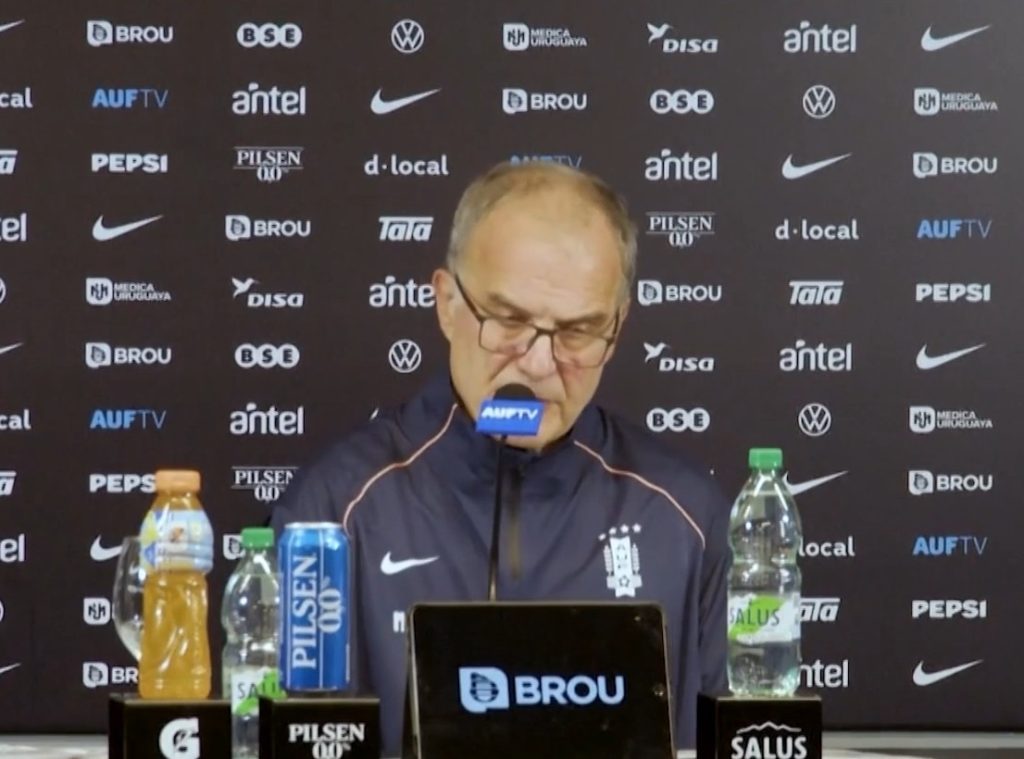
In an emotional 90-minute press conference, Bielsa addressed the criticism surrounding Uruguay’s campaign, accepted responsibility for the team’s failure, and revealed for the first time the difficulties he experienced inside the dressing room.
“Did I win over the players? No,” Bielsa admitted. “Did they feel comfortable working with me? No. I can say that I have a relationship of affection with two or three of them, but that’s all.”
Uruguay managed just two points from matches against Cape Verde, Saudi Arabia and Spain, finishing outside the qualification places and suffering one of the biggest disappointments of the tournament.
Bielsa made no attempt to hide his frustration.
“This ending is very painful,” he said. “When I accepted this project, I had enormous hopes. It hurts because of the way it ended and because of the effort everyone invested, especially the players, who always showed tremendous commitment. I have no excuses for why this team collected only two points from three matches.”
In recent days, speculation had suggested that Bielsa had completely lost the dressing room. The former Leeds United, Marseille and Argentina coach rejected that interpretation, insisting communication with the squad remained open throughout the tournament.
“I held meetings with the players so they could tell me exactly what they didn’t like about my way of working,” Bielsa revealed.
“The first thing they told me was that I gave them too much information. So I cut it by more than half. I simplified my messages and made them easier to understand. When that still didn’t work, I stopped doing those things altogether.”
Despite making changes, Bielsa acknowledged he was unable to create the environment he had hoped for.
Still, he firmly rejected the idea that the players had quit on him.
“One former Uruguay international said it was obvious the team and the coach were divided,” Bielsa said. “I completely disagree.”
He pointed to the team’s physical statistics as evidence that the squad continued to fight until the end.
“We ran 20 percent more than Saudi Arabia, 30 percent more than Cape Verde and 25 percent more than Spain. Those numbers don’t belong to a team that has stopped believing in its coach.”
Known throughout his career for his obsessive attention to detail and demanding training methods, Bielsa has often inspired deep admiration while also creating intense pressure inside the teams he manages.
In Uruguay, however, the relationship never fully developed into the partnership he envisioned.
His departure closes one of the most anticipated coaching projects in South American football—a project that began with high expectations but ultimately ended in disappointment after an early World Cup exit.
As Uruguay begin searching for a new head coach, Bielsa leaves with characteristic honesty, accepting responsibility for the failure while refusing to blame the players who, despite their differences with his methods, continued to fight until the final whistle.