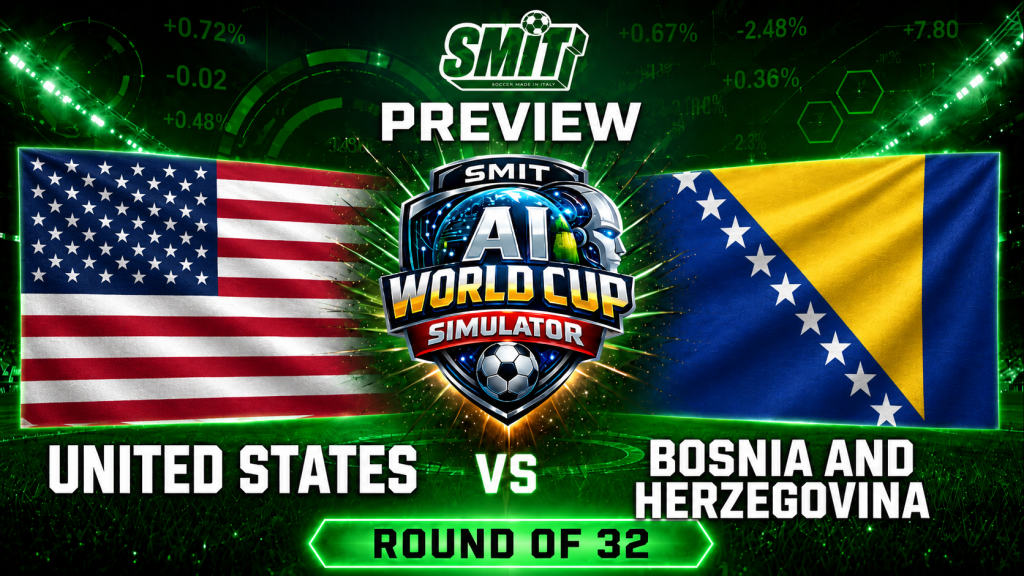
The United States and Bosnia and Herzegovina meet in Santa Clara in a Round of 32 matchup that carries enormous stakes for both programs. The host nation enters the knockout stage with attacking confidence, home-field energy and the pressure of expectation. Bosnia and Herzegovina arrive as resilient third-place qualifiers, led by veteran experience, playoff-tested belief and one of the great emotional stories of World Cup 2026.
The Big Picture
The United States reached the knockout stage exactly where it wanted to be: first place in Group D, playing on home soil, and positioned for a potentially historic run.
Mauricio Pochettino’s team opened the tournament with a 4-1 win over Paraguay, followed it with a controlled 2-0 victory against Australia, then lost 3-2 to Türkiye in the final group match. The defeat did not cost the U.S. the group, but it changed the tone around this Round of 32 tie. It reminded the Stars and Stripes that knockout football is not about momentum alone. It is about control, concentration and managing the difficult moments.
That is why Pochettino’s caution matters. After seeing major European teams fall in the Round of 32, the U.S. coach warned against treating Bosnia as a simple matchup. Germany’s exit against Paraguay and the Netherlands’ elimination by Morocco showed how quickly a favorite can lose control in this expanded knockout format.
Bosnia and Herzegovina arrive with nothing close to the same pressure. Sergej Barbarez’s team reached the World Cup through an emotional playoff path, then survived Group B with four points: a 1-1 draw against Canada, a 4-1 loss to Switzerland and a 3-1 win over Qatar. That final result pushed the Dragons into the knockout stage for the first time in their history.
The tactical story is clear. The United States want tempo, pressure, wing-back width and attacking combinations around Christian Pulisic, Folarin Balogun, Weston McKennie and Sergiño Dest. Bosnia want compactness, direct transitions and the leadership of Edin Džeko and Ermedin Demirović up front.
The U.S. are the favorites. But Bosnia are organized enough, experienced enough and emotionally free enough to make this match uncomfortable if it stays close.
Recent Form
The United States enter with one of the most explosive attacking profiles in the Round of 32, but also with defensive questions.
Across the last five matches provided, the U.S. have three wins and two losses, with 12 goals scored and eight conceded. The attacking production is strong. The defensive numbers are less convincing. Using the SMIT knockout-stage model — 70 percent weight on the three World Cup group-stage matches and 30 percent on the previous recent fixtures — the U.S. form rating remains positive because of the wins over Paraguay and Australia, but the loss to Türkiye lowers the defensive-stability score.
The 4-1 win over Paraguay was the best version of this team: aggressive, vertical, confident and efficient in transition. The 2-0 win over Australia showed more control and better defensive balance. The 3-2 loss to Türkiye exposed the risk of leaving too much space behind the wing-backs and losing structure when the game becomes chaotic.
The U.S. have scored eight goals in the group stage, which places them among the stronger attacking teams in the tournament. Balogun’s movement, Pulisic’s creativity and McKennie’s box-to-box timing give Pochettino multiple ways to create chances. But the U.S. have also conceded four goals in three World Cup matches, and that is the area Bosnia will try to attack.
Bosnia and Herzegovina’s recent form is more modest but resilient.
Across the last five matches provided, the Dragons have one win, three draws and one loss, with six goals scored and seven conceded. The World Cup group-stage sample tells a similar story: Bosnia can compete, but its margins are thin. The 1-1 draw against Canada was disciplined. The 4-1 defeat to Switzerland exposed defensive gaps. The 3-1 win over Qatar showed character and attacking improvement when the tournament was on the line.
The most important trend is Bosnia’s ability to respond under pressure. This team came through playoff shootouts before the tournament and then delivered in a must-win group match. Reuters reported before the Qatar game that Barbarez wanted a more attacking approach with Bosnia’s World Cup future at stake, and that shift helped the Dragons reach this stage.
Bosnia are not likely to dominate possession against the U.S. Their best route is to slow the rhythm, protect central zones and use Džeko, Demirović, Esmir Bajraktarević and Kerim Alajbegović to attack moments rather than long spells.
Tactical Keys
The United States are expected to line up in a 3-4-2-1.
Matt Freese should start in goal, with Alex Freeman, Chris Richards and Tim Ream forming the back three. Sergiño Dest and Antonee Robinson are projected as the wing-backs, giving the U.S. speed, width and attacking width on both sides. Tyler Adams and Weston McKennie provide the central base, with Christian Pulisic and Malik Tillman supporting Folarin Balogun.
The main tactical objective for the U.S. is to create pressure without losing balance. Dest and Robinson can pin Bosnia’s wide players deep, but if both push high at the same time, Bosnia can counter into the channels. Adams’ positioning will be crucial. He must protect the space in front of the back three and stop quick vertical balls into Džeko and Demirović.
Pulisic’s role is equally important. In the supplied lineup, he starts as one of the two attacking midfielders rather than as a traditional winger. That gives him freedom to receive between the lines, drift left and combine with Robinson, or attack centrally around Balogun. If Pulisic is fit and sharp, he is the player most likely to break Bosnia’s block.
Bosnia are expected to use a 4-4-2.
Nikola Vasilj should start in goal, with Amar Dedić, Nikola Katić, Tarik Muharemović and Sead Kolašinac across the back line. Benjamin Tahirović and Ivan Bašić are projected in central midfield, with Bajraktarević and Alajbegović providing wide support. Džeko and Demirović lead the attack.
Bosnia’s plan should be direct and disciplined. Džeko can still hold the ball, win aerial duels and bring teammates into the game. Demirović gives more mobility around him. If Bosnia can bypass the U.S. press and force Ream or Richards into backward-running defensive actions, the Dragons can create danger.
The biggest tactical question is whether Bosnia can survive the U.S. press in the first 30 minutes. If the U.S. score early, Bosnia will have to open up. If Bosnia keep it 0-0 deep into the second half, the pressure will shift heavily toward the host nation.
Team News
Christian Pulisic is expected to be fit to start after being managed carefully against Türkiye. That is a major boost for the U.S., because his ability to receive between the lines and attack defenders directly is central to Pochettino’s knockout plan. Reuters reports that Pulisic is fit, while Mark McKenzie is expected to miss the match with a foot injury and Auston Trusty could be available from the bench after an ankle issue.
The supplied probable lineup has Matt Freese in goal, with Freeman, Richards and Ream in the back three. Adams and McKennie are expected in midfield, while Dest and Robinson provide width. Pulisic and Tillman are projected behind Balogun.
That shape gives Pochettino attacking balance, but also demands defensive discipline from the wing-backs. The U.S. cannot allow Bosnia to turn every clearance into a counterattack.
Bosnia and Herzegovina have no confirmed injuries or suspensions listed in the provided material.
Tarik Muharemović is expected to return to the lineup and strengthen the back four. Vasilj should start in goal, with Dedić, Katić, Muharemović and Kolašinac in defense. Tahirović and Bašić are expected to anchor midfield, while Bajraktarević and Alajbegović provide wide support for the Džeko-Demirović pairing.
Džeko remains the emotional and tactical reference point. Even at 40, his intelligence, hold-up play and penalty-area instincts make him Bosnia’s most important attacking connector.
Key Battles
Christian Pulisic vs Tarik Muharemović
Pulisic’s freedom between the lines can create serious problems for Bosnia. Muharemović’s return gives the Dragons more defensive solidity, but he must decide when to step toward Pulisic and when to hold the line. If Pulisic repeatedly turns in central areas, the U.S. attack can accelerate quickly.
Folarin Balogun vs Nikola Katić
Balogun’s movement behind the defense is a major part of the U.S. attack. Katić must control depth, avoid being dragged out and stay connected with Muharemović. If Balogun stretches Bosnia’s center backs, space opens for Pulisic and Tillman.
Weston McKennie vs Benjamin Tahirović
McKennie’s energy, aerial ability and late runs give the U.S. a physical edge in midfield. Tahirović must limit second balls and stop McKennie from turning transitions into attacking waves. This duel could shape the tempo of the match.
Sergiño Dest vs Kerim Alajbegović
Dest gives the U.S. width and creativity from the right, but his advanced positioning can leave space behind. Alajbegović must be ready to attack those spaces quickly. If Bosnia can force Dest to defend more than attack, it can slow the American rhythm.
Edin Džeko vs Tim Ream
This is a duel of experience. Džeko will try to use his body, timing and intelligence to bring Bosnia up the field. Ream must stay tight without fouling and prevent Džeko from becoming the platform for Bosnia’s counterattacks.
What’s at Stake
For the United States, this match is about more than reaching the Round of 16.
As co-hosts, the Stars and Stripes are carrying national expectations. A Round of 32 exit would be viewed as a major failure, especially after winning the group and landing a favorable knockout draw on home soil. The U.S. program has spent years building toward this tournament, and this is the kind of game it is expected to win.
For Bosnia and Herzegovina, this is already historic. The Dragons have reached the knockout stage of a World Cup for the first time, and every step from here would be a national milestone. Beating the United States on American soil would instantly become one of the greatest results in Bosnian football history.
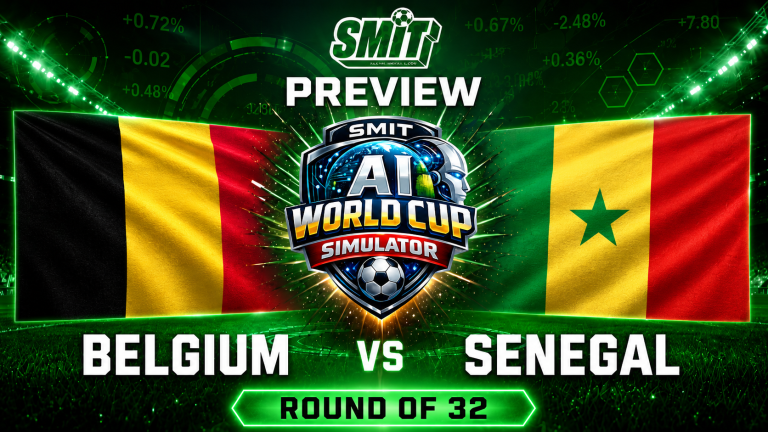
The winner will face Belgium in the Round of 16. Belgium advanced after a narrow win over Senegal, meaning the next round would bring a major European test for either the host nation or a historic Bosnian underdog.
Probable Lineups
United States Probable Lineup
Formation: 3-4-2-1
Matt Freese; Alex Freeman, Chris Richards, Tim Ream; Sergiño Dest, Weston McKennie, Tyler Adams, Antonee Robinson; Christian Pulisic, Malik Tillman; Folarin Balogun.
Bosnia and Herzegovina Probable Lineup
Formation: 4-4-2
Nikola Vasilj; Amar Dedić, Nikola Katić, Tarik Muharemović, Sead Kolašinac; Esmir Bajraktarević, Benjamin Tahirović, Ivan Bašić, Kerim Alajbegović; Edin Džeko, Ermedin Demirović.
SMIT AI WORLD CUP SIMULATOR
Squad Strength Index
| Team | Goalkeeping | Defense | Midfield | Attack | Depth | Total |
|---|---|---|---|---|---|---|
| United States | 7.9 | 7.8 | 8.2 | 8.4 | 8.0 | 80.6 |
| Bosnia and Herzegovina | 7.6 | 7.4 | 7.2 | 7.5 | 7.0 | 73.4 |
The United States score higher overall because of attacking depth, home advantage, wing-back quality and the Pulisic-Balogun-McKennie core. Bosnia score well in goalkeeper reliability, veteran experience and forward intelligence, but the defensive issues shown against Switzerland lower the total.
Expected Goals Simulation
| Team | Projected xG | Shot Quality Trend | Defensive Risk | Set-Piece Threat |
| United States | 1.82 | High | Medium | Medium-high |
| Bosnia and Herzegovina | 1.04 | Medium | Medium-high | High |
The simulation projects the U.S. to create more chances through pressure, wing-back width and Pulisic’s movement between the lines. Bosnia’s xG is built mainly from direct play, Džeko’s aerial presence, Demirović’s movement and set-piece opportunities.
Win Probability
| Outcome | Probability |
| United States win in 90 minutes | 57% |
| Draw after 90 minutes | 26% |
| Bosnia and Herzegovina win in 90 minutes | 17% |
| United States advance overall | 70% |
| Bosnia and Herzegovina advance overall | 30% |
The U.S. are favorites because of home advantage, stronger group-stage attacking output and better squad depth. Bosnia’s 30 percent overall advancement probability reflects its experience, set-piece threat and ability to keep knockout matches tense.
Four Most Likely Results
| Result | Probability |
| United States 2-1 Bosnia and Herzegovina | 19% |
| United States 2-0 Bosnia and Herzegovina | 16% |
| United States 1-1 Bosnia and Herzegovina, United States advance after extra time | 12% |
| United States 1-0 Bosnia and Herzegovina | 11% |
Most Likely Result
United States 2-1 Bosnia and Herzegovina
The SMIT AI Simulator predicts the United States to advance to the Round of 16 with a narrow 2-1 win after 90 minutes.
Predicted Goalscorers
United States: Christian Pulisic, Folarin Balogun
Bosnia and Herzegovina: Edin Džeko
Player of the Simulation
Christian Pulisic, United States
Pulisic is projected as the decisive player because of his fitness, freedom between the lines and ability to turn possession into direct attacking chances in the final third.
Confidence Level
Medium-high
The United States have stronger current tournament data, home-field advantage and more attacking variety. Bosnia’s direct style, set-piece danger and emotional resilience keep the projection from becoming high confidence.
AI Match Simulation
The simulation begins with the United States pressing high and trying to establish territorial control. Dest and Robinson push wide, Adams protects the middle and McKennie looks to win second balls around Bosnia’s midfield line. Bosnia sit compact early, with Džeko and Demirović staying ready for direct passes into the channels.
The first American chance comes through Pulisic. He receives between the lines, turns quickly and finds Balogun running behind Katić. Vasilj closes the angle well and blocks the shot, giving Bosnia an early warning.
The U.S. keep pushing, but Bosnia defend with discipline. Kolašinac and Dedić stay narrow, Muharemović steps aggressively when Pulisic receives, and Bašić helps clog the center. For the first half hour, the match is more tense than open.
The breakthrough comes from an American overload on the left. Robinson advances, combines with Pulisic and pulls Bosnia’s defensive line across the field. Pulisic receives the return pass inside the box and finishes low into the far corner. The U.S. lead 1-0, and the home crowd finally gets release.
Bosnia respond before halftime with their most reliable weapon: experience. Džeko drops deep to receive, Demirović runs beyond him, and the U.S. back line is forced to retreat. A set-piece follows, and Bosnia use the moment well. Džeko attacks the delivery and powers a header past Freese to make it 1-1.
The equalizer changes the mood. The U.S. become more cautious early in the second half, aware of how dangerous Bosnia can be if the match becomes emotional. Pochettino’s team gradually restores control through Adams and McKennie, while Tillman begins to find more space around Bosnia’s midfield.
The decisive goal arrives in the final 25 minutes. Dest receives wide on the right, cuts inside and finds McKennie in the half-space. McKennie plays early into Balogun, who spins off Katić and finishes with one touch. The U.S. lead 2-1.
Bosnia push late, sending more direct balls toward Džeko and Demirović. Alajbegović creates one dangerous cross, and Vasilj comes forward for a stoppage-time set piece, but Richards and Ream clear the final danger.
According to the SMIT AI Simulator, the United States advance with a 2-1 win — a tense, emotional knockout match decided by home energy, Pulisic’s quality and Balogun’s movement in the box.
Why the Simulator Predicts This Result
The simulation gives the United States the edge for five main reasons.
First, the U.S. group-stage attacking output is stronger. Eight goals in three matches, including four against Paraguay and two against Australia, give Pochettino’s side a higher chance-creation baseline than Bosnia.
Second, home advantage matters. Playing in California with a pro-American crowd gives the U.S. emotional lift and can increase pressure on Bosnia during long defensive phases.
Third, Pulisic’s availability changes the attacking model. With Pulisic fit to start, the U.S. have a central creator who can receive between lines, combine with Balogun and create from broken defensive shapes.
Fourth, Bosnia’s defensive profile remains vulnerable against high-tempo attacks. The Dragons conceded four against Switzerland and seven across the last five listed matches. Against the U.S. wing-back system, that raises the defensive-risk rating.
Fifth, Bosnia’s upset path is real but narrow. Džeko, Demirović and set pieces can keep the match close, but Bosnia are unlikely to create enough sustained pressure to match the U.S. chance volume over 90 minutes.
The SMIT AI Simulator projects Bosnia to score because of Džeko’s presence and set-piece threat, but the United States have more attacking options, more speed in wide areas and more control late in the match.