
South Africa and Canada meet in Los Angeles with history on the line. For Bafana Bafana, this is the nation’s first-ever appearance in the knockout stage of a men’s FIFA World Cup. For Canada, it is a chance to turn a breakthrough home tournament into a defining national soccer moment. One of these two teams will reach the Round of 16. The other will leave with pride, but also with the feeling that a rare opportunity slipped away.
The Big Picture
South Africa vs Canada is not the loudest Round of 32 matchup on paper, but it may be one of the most meaningful.
Both nations arrive at this stage chasing a new ceiling. South Africa had never moved beyond the group stage before this tournament. Canada entered the 2026 World Cup still searching for its first true knockout statement on the global stage. Now, at Los Angeles Stadium, the bracket has opened a historic lane for one of them.
South Africa’s tournament has been built on resilience. Hugo Broos’ side started with a 2-0 defeat against Mexico, a match complicated by discipline issues and two red cards. Instead of collapsing, Bafana Bafana adjusted. They earned a 1-1 draw against Czechia, then delivered when it mattered most with a 1-0 win over South Korea. That result pushed South Africa into uncharted territory.
Canada’s path has been more explosive. Jesse Marsch’s team opened with a 1-1 draw against Bosnia and Herzegovina, then produced one of the most emphatic group-stage results of the tournament with a 6-0 win over Qatar. The 2-1 defeat to Switzerland on Matchday 3 did not stop Canada from advancing, but it did expose some of the defensive and midfield questions that could matter in a knockout game.
This is a stylistic clash as much as a historic one: South Africa’s organization, compact defending and counterattacking rhythm against Canada’s vertical speed, attacking firepower and front-foot mentality.
Recent Form
South Africa’s recent form tells the story of a team that has grown into the tournament.
In their last three World Cup matches, Bafana Bafana scored two goals and conceded three. That may not sound spectacular, but the trend is important. After allowing two goals against Mexico in the opener, South Africa conceded only one goal across the next two matches. The defensive structure tightened, Ronwen Williams remained a stabilizing presence in goal, and the back line gained confidence.
The 1-1 draw against Czechia was a turning point. South Africa showed more control, more patience and more tactical maturity. The 1-0 win over South Korea confirmed the improvement. Bafana Bafana were not dominant in possession, but they were disciplined, aggressive in the right moments and dangerous enough in transition to punish space.
The broader five-game sample also supports the same profile: South Africa has been involved in low-scoring matches, with only three goals scored and three conceded across the latest five listed games. This is not a team built to overwhelm opponents. It is a team built to survive, frustrate and strike.
Canada’s form is more volatile but more dangerous.
The Canucks have scored eight goals in their three World Cup matches, with the 6-0 win over Qatar heavily boosting their attacking numbers. Jonathan David’s finishing, Cyle Larin’s presence and Tajon Buchanan’s ability to attack wide spaces give Canada a higher offensive ceiling than South Africa.
But Canada has also conceded in two of its three group-stage matches. The 2-1 loss to Switzerland was not disastrous, but it showed that Marsch’s team can be stretched when the opponent plays through pressure or attacks the space behind the fullbacks. Canada’s pressing identity brings energy and chances, but also risk.
Using the SMIT knockout-stage form model — 70 percent weight on the three World Cup group-stage matches and 30 percent on the previous recent fixtures — Canada enters with the better attacking trend, while South Africa enters with the cleaner defensive trend. That balance is exactly why the simulator projects a tight match.
Tactical Keys
South Africa’s main tactical priority will be to keep the game compact.
Broos is expected to rely on a 4-2-3-1 structure, with Ronwen Williams in goal and a back four built around Khuliso Mudau, Ime Okon, Mbekezeli Mbokazi and Aubrey Modiba. The key is spacing. South Africa cannot allow Canada’s front two to receive early balls between the center backs, and the midfield screen must protect the central channel where Jonathan David is most dangerous.
In possession, South Africa will likely avoid long periods of slow buildup. The better route is direct but controlled: win the ball, find Relebohile Mofokeng or Oswin Appollis quickly, and attack Canada before its defensive block is fully set. Thapelo Maseko’s movement from wide areas could also be decisive, especially if Canada’s fullbacks push high.
Canada’s tactical identity is more aggressive. Marsch’s team is expected to use a 4-4-2, with Cyle Larin and Jonathan David together up front. That shape gives Canada two reference points in the box and allows Buchanan to attack from wide zones, but it also places major responsibility on Stephen Eustáquio and Nathan Saliba to control transitions.
Canada’s best moments should come from pressing triggers: forcing South Africa into rushed clearances, winning second balls and attacking quickly through David, Larin and Buchanan. But if South Africa bypasses the first wave of pressure, Canada could be vulnerable in the spaces behind the midfield line.
The biggest tactical question is whether Canada can win the match without turning it into a track meet. South Africa would welcome a low-tempo, low-scoring game. Canada wants speed, pressure and repeated entries into the penalty area.
Team News
South Africa’s projected lineup is based on the supplied probable formation and available squad list. Hugo Broos is expected to stay close to the core that carried Bafana Bafana into the knockout stage.
Ronwen Williams should start in goal, with Mudau, Okon, Mbokazi and Modiba forming the back four. In midfield, Thalente Mbatha is expected to play an important role in ball-winning and coverage. Teboho Mokoena is a major storyline after missing the South Korea match through suspension, although the supplied probable lineup also shows Sphephelo Sithole as part of the midfield structure. Further confirmation will come closer to kickoff.
In attack, South Africa’s likely front line includes Mofokeng, Appollis, Maseko and Evidence Makgopa. Lyle Foster remains one of the most recognizable attacking names in the squad, but Makgopa is projected as the central striker in the supplied lineup.
Themba Zwane is listed among the unavailable players.
Canada’s projected XI has Maxime Crépeau in goal, with Alistair Johnston, Luc de Fougerolles, Derek Cornelius and Richie Laryea across the back line. The midfield is expected to feature Tajon Buchanan, Nathan Saliba, Stephen Eustáquio and Ali Ahmed, with Cyle Larin and Jonathan David leading the attack.
Ismaël Koné is unavailable after the injury suffered during the tournament. Alphonso Davies remains one of the biggest names on the Canadian roster, but he has not been included in the supplied probable starting lineup. Canada’s lineup therefore points toward Laryea continuing in the defensive role, with Marsch relying on David, Larin and Buchanan to provide the main attacking punch.
Key Battles
Jonathan David vs Ime Okon and Mbekezeli Mbokazi
David is Canada’s most dangerous finisher and the player most capable of deciding a tight knockout match with one clean touch. South Africa’s young central defenders must stay connected, deny him space between the lines and avoid being pulled out of shape by Larin’s movement.
Relebohile Mofokeng vs Richie Laryea
Mofokeng was one of South Africa’s brightest performers during the group stage. His ability to carry the ball, draw defenders and create separation could be South Africa’s best attacking weapon. Laryea has the athleticism to match him, but he cannot afford to lose concentration when Canada pushes forward.
Stephen Eustáquio vs South Africa’s midfield screen
Eustáquio is central to Canada’s rhythm. If he controls tempo, Canada can move the ball into dangerous areas early and repeatedly. If South Africa disrupts him, the match becomes more fragmented — exactly the kind of game Bafana Bafana can survive.
Tajon Buchanan vs Aubrey Modiba
Buchanan’s pace and direct running can tilt the field. Modiba’s job is not only to defend one-on-one, but also to manage when to step, when to delay and when to force Buchanan backward. This duel could determine how much pressure South Africa faces from wide areas.
What’s at Stake
This is the Round of 32, but for both teams it feels bigger than that.
For South Africa, victory would mean a first-ever place in the Round of 16 at a men’s World Cup. It would instantly become one of the greatest achievements in Bafana Bafana history, alongside the iconic 2010 win over France and the country’s proudest African football moments.
For Canada, this is a chance to validate the growth of an entire soccer generation. Hosting the tournament raised expectations. Advancing from the group was important. Winning a knockout match would take the program to a new level.
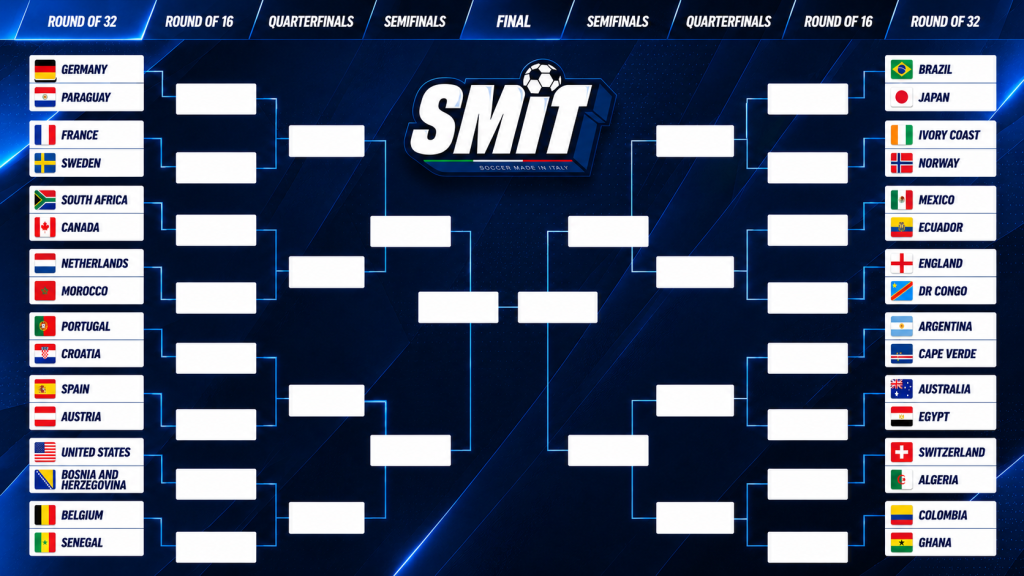
The winner will face the winner of Netherlands vs Morocco in the Round of 16. That makes this match even more compelling: one historic step here would put either South Africa or Canada within 90 minutes of a World Cup quarterfinal.
Probable Lineups
South Africa Probable Lineup
Formation: 4-2-3-1
Ronwen Williams; Khuliso Mudau, Ime Okon, Mbekezeli Mbokazi, Aubrey Modiba; Thalente Mbatha, Sphephelo Sithole; Thapelo Maseko, Relebohile Mofokeng, Oswin Appollis; Evidence Makgopa.
Canada Probable Lineup
Formation: 4-4-2
Maxime Crépeau; Alistair Johnston, Luc de Fougerolles, Derek Cornelius, Richie Laryea; Tajon Buchanan, Nathan Saliba, Stephen Eustáquio, Ali Ahmed; Cyle Larin, Jonathan David.
SMIT AI WORLD CUP SIMULATOR
Squad Strength Index
| Team | Goalkeeping | Defense | Midfield | Attack | Depth | Total |
|---|---|---|---|---|---|---|
| South Africa | 8.0 | 7.3 | 7.0 | 6.8 | 6.7 | 71.6 |
| Canada | 7.4 | 7.2 | 7.6 | 8.3 | 7.4 | 75.8 |
Canada receives the higher overall score because of its attacking ceiling, the David-Larin pairing and its stronger goal production during the group stage. South Africa scores higher in goalkeeping and defensive cohesion, especially after conceding only once across its last two World Cup matches.
Expected Goals Simulation
| Team | Projected xG | Shot Quality Trend | Defensive Risk | Set-Piece Threat |
| South Africa | 1.05 | Moderate | Low-to-medium | Medium |
| Canada | 1.42 | High | Medium | Medium-high |
The simulation projects Canada to create the better chances, but not by a wide margin. South Africa’s compact block reduces open-play volume, while Canada’s pressing and front two generate more high-value attacking sequences.
Win Probability
| Outcome | Probability |
| South Africa win in 90 minutes | 24% |
| Draw after 90 minutes | 31% |
| Canada win in 90 minutes | 45% |
| South Africa advance overall | 36% |
| Canada advance overall | 64% |
Because this is a knockout match, the SMIT AI Simulator must project an advancing team. Canada is favored overall, but the draw-after-90 probability is significant. South Africa’s defensive structure gives Bafana Bafana a realistic path to extra time or penalties if they keep the match low-scoring.
Four Most Likely Results
| Result | Probability |
| South Africa 1-2 Canada | 18% |
| South Africa 1-1 Canada, Canada advance after extra time | 15% |
| South Africa 0-1 Canada | 14% |
| South Africa 1-1 Canada, Canada advance on penalties | 11% |
Most Likely Result
South Africa 1-2 Canada
The SMIT AI Simulator predicts Canada to advance to the Round of 16 with a narrow 2-1 win after 90 minutes.
Predicted Goalscorers
South Africa: Relebohile Mofokeng
Canada: Jonathan David, Cyle Larin
Player of the Simulation
Jonathan David, Canada
David’s movement, finishing efficiency and chemistry with Larin make him the decisive player in the simulation.
Confidence Level
Medium
Canada has the stronger attacking profile and more goal production, but South Africa’s defensive trend and knockout-stage discipline lower the margin of certainty. The simulator sees Canada as the better team on balance, but not by enough to rule out extra time.
AI Match Simulation
The simulation begins with Canada trying to impose tempo immediately. Marsch’s side presses high, using Larin and David to close South Africa’s center backs while Buchanan looks to attack the right channel. South Africa absorbs the first wave, with Williams organizing the box and Mbokazi stepping into several important duels.
Canada creates the first major chance through Buchanan, whose low cross finds David near the penalty spot, but the finish is blocked by Okon. South Africa responds in transition. Mofokeng drifts inside from the right, combines with Appollis and forces Crépeau into a sharp save.
The opening goal arrives midway through the first half. Canada’s pressure forces a turnover in midfield, Eustáquio moves the ball quickly into David, and the Juventus forward finishes low into the corner. Canada leads 1-0, but the match does not open up completely. South Africa stays patient and keeps the scoreline within reach.
Early in the second half, Bafana Bafana find their moment. Mofokeng receives between the lines, attacks Laryea one-on-one and creates just enough space to drive a shot across goal. The equalizer shifts the energy of the match. South Africa grows in belief, while Canada briefly loses control of the rhythm.
The decisive sequence comes in the final 20 minutes. Canada pushes higher, adds more bodies around the box and begins to win second balls. A wide delivery from the right forces South Africa’s defense to retreat, and Larin attacks the space between the center backs to finish from close range.
South Africa throws numbers forward late, with Maseko and Appollis trying to create one final chance in transition. Williams comes up for a stoppage-time set piece, but Canada survives the pressure.
According to the SMIT AI Simulator, Canada advances with a 2-1 win — not because the match is comfortable, but because its attacking quality produces one more decisive moment than South Africa’s compact defensive structure can handle.
Why the Simulator Predicts This Result
The simulation gives Canada the edge for three main reasons.
- First, Canada’s attacking output during the group stage was significantly stronger. Even with the 6-0 win over Qatar inflating the numbers, the Canucks showed a higher chance-creation ceiling than South Africa. David and Larin provide a proven two-forward structure, while Buchanan gives Canada direct running from wide areas.
- Second, South Africa’s improvement is real, but its margin for error is narrow. Bafana Bafana have defended better since the Mexico defeat, yet they have not produced enough attacking volume to consistently chase a game. If Canada scores first, South Africa must move out of its preferred low-risk rhythm.
- Third, the matchup favors Canada in the penalty-area battle. South Africa can frustrate Canada for long stretches, but over 90 minutes the simulator projects Marsch’s team to create slightly more high-quality chances through pressing, second balls and service into the front two.
The SMIT AI Simulator does not project a blowout. It projects a tense, historic knockout match decided by execution in the final third. Canada has the sharper attacking tools, South Africa has the stronger underdog structure, and the difference is one late goal.