Allegri vs Gasperini – Matchday 10 of Serie A brings a standout clash as Gasperini’s Roma, the surprise league leaders, visit Allegri’s Milan. The first intriguing stat about this matchup concerns the two managers, who have faced each other 29 times — the most for both against any other coach. The record clearly favors the Rossoneri boss, with 13 wins, 10 draws, and just 6 losses. The figure becomes even more telling if we exclude their first four encounters between 2008/09 and 2009/10, when Allegri’s Cagliari met Gasperini’s Genoa — three losses and one win for the Tuscan. Since 2010, they’ve met 25 times, and the Piedmontese coach has won only three of those — the last on November 27, 2021, a 1-0 victory thanks to Duván Zapata. Since then: four draws and two defeats, the latest in the 2024 Coppa Italia final decided by Dušan Vlahović.
Allegri’s tactical style tends to neutralize Gasperini’s footballing dynamics. His precisely drilled positional defense leaves little room for Gasperini’s attacking patterns to find gaps, while his counterattacks often target the defensive vulnerabilities of the former Atalanta coach’s sides.
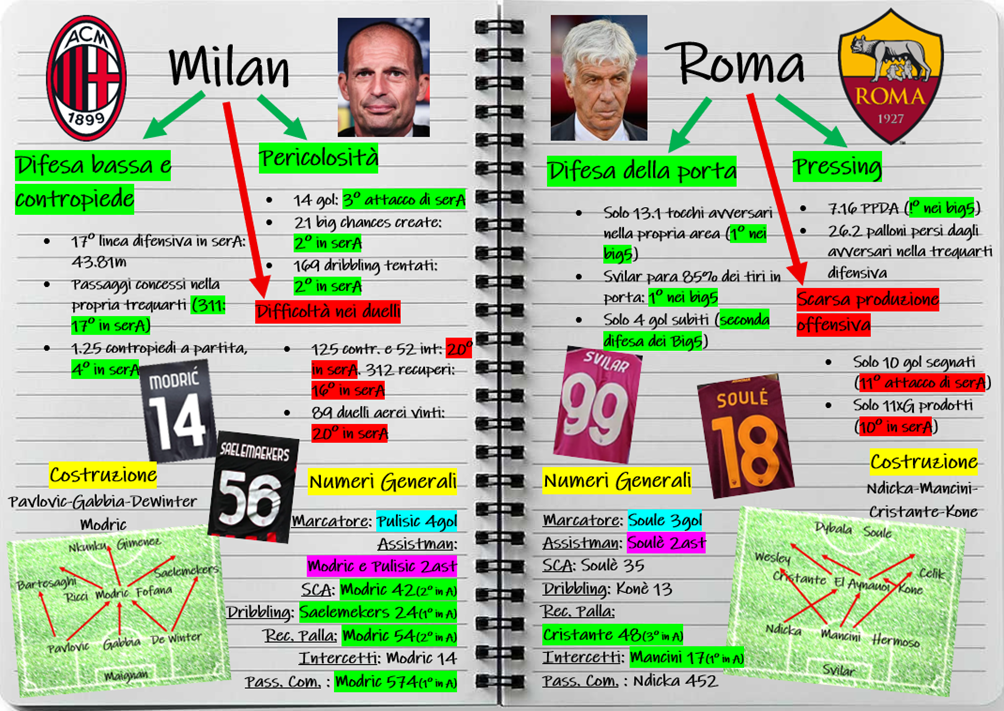
Milan in waiting mode – Milan’s numbers are well-known by now: strong defensive compactness, a structured positional setup, and a style that rarely presses high. Allegri is content to sit deep, even in his own box if needed, before launching rapid transitions exploiting the technical, athletic, and physical qualities of his wingers and forwards.
• With 7 goals conceded, Milan have the third-best defense in Serie A.
• Their average defensive line sits at 43.81 meters from goal — the 17th deepest in the league.
• They also rank 17th for passes allowed in their own defensive third and last for crosses conceded.
• Their dueling stats are low: bottom in Serie A for interceptions, tackles, and aerial duels, and 16th for ball recoveries — though Modric ranks 2nd in the league individually in that category.
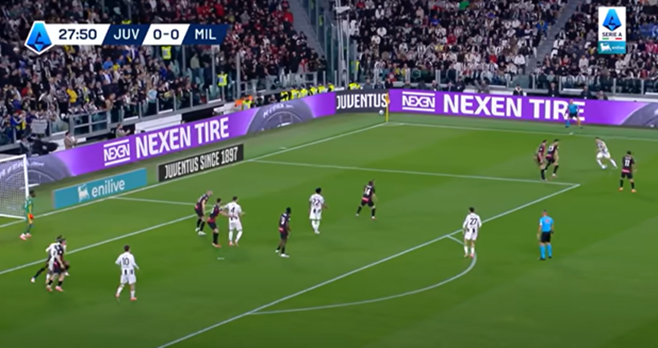
Nine men defending Milan’s box
Milan doesn’t press to trigger transitions — instead, they lure opponents into their own half before hitting on the break.
• They allow opponents to build freely, ranking last in Serie A for opponent passing accuracy during buildup (89%, very high compared to other top sides).
• They concede long possession spells: 18th in Serie A for consecutive opponent passes (15.15 on average).
• Milan sits deep to counter and are 4th in Serie A for counterattacking moves — the best among the top clubs.
Their offensive volume isn’t huge, but their attacking efficiency remains among the league’s best:
• 8th for shots on target and 6th for touches in the attacking third.
• Yet they boast Serie A’s 3rd-best attack with 14 goals (top scorer: Pulisic with 4).
• 4th for expected goals created (12.1; Gimenez accounts for 2.8) and for touches in the opponent’s box (224).
• 2nd for big chances created (21).
• 2nd for dribbles attempted and 3rd for completed dribbles — Saelemaekers leads Serie A with 24.
• 3rd for carries into the attacking area.
Roma on the front foot – If Allegri waits, Gasperini presses. Roma have the second-best defense in Europe, the product of an aggressive, high line meticulously tailored for each opponent. As noted weeks ago, Roma leave plenty of space behind, but breaking through is tough — and once you do, there’s still Mile Svilar to beat.
• Roma have conceded just 0.44 goals per game; among Europe’s top five leagues, only Arsenal have done better.
• Goalkeeper Mile Svilar has saved 84.6% of shots faced — the best figure across Europe’s top five leagues.
• Roma allow the fewest opposition touches in their own box across the big five leagues: just 13.1 per game.
These numbers are the result of a coordinated, well-rehearsed pressing system:
• Roma rank first in Europe for PPDA (7.16), the fewest opponent passes allowed before a defensive action — less than half Milan’s figure (15.15).
• They also lead Serie A for opponent turnovers near the penalty area (26.2 per game).
• They’re 1st in Serie A for ball recoveries — the famous “second balls” — with 391 total. Three Roma players rank in the league’s top 10: Cristante, Kone, and N’Dicka.
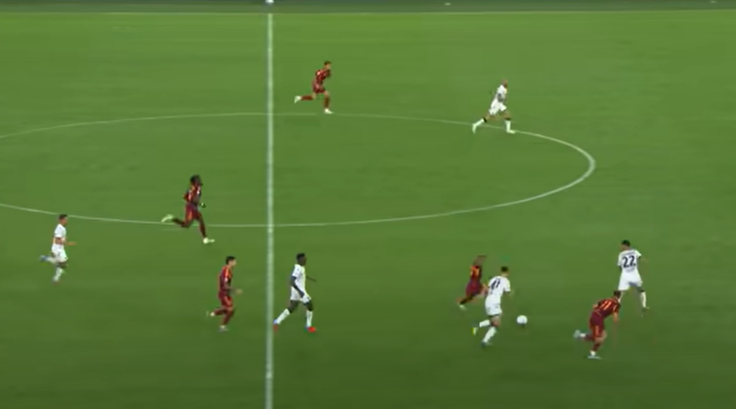
At the first poor touch from an opponent, Roma immediately swarm the ball
Thanks to this intense press, Gasp’s team generates strong attacking volume in the final third:
• 2nd in Serie A for carries into the attacking third.
Yet, they struggle to convert that pressure into goals:
• 11th-best attack in Serie A with 10 goals (top scorer: Soulé with 3).
• 10th for expected goals created (11; Dovbyk accounts for 2).
• 11th for completed crosses into the box.
Milan’s buildup – As mentioned recently, Modric is by far Serie A’s most prolific passer (575 completed, ahead of Bastoni’s 533). Milan’s play flows almost entirely through him — the Croatian acts as a constant outlet for the back three before finding the wide men or forwards. The former Real Madrid man uses his ball-carrying ability to drive transitions and “turn defense into attack,” as a famous commentator once said, before releasing runners into space. Milan’s strength lies in players like Saelemaekers, Pulisic, Leão, and Nkunku, who can receive both to feet and on the run — combining technical skill and athleticism while keeping risks minimal.
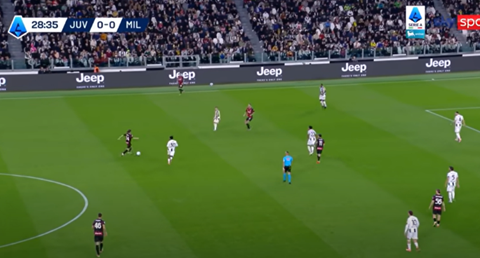
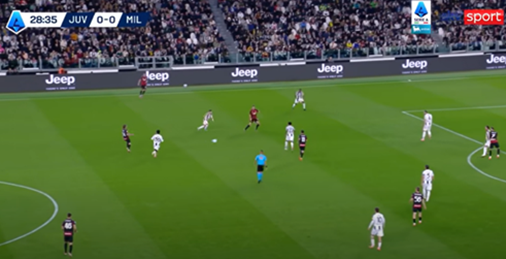
Modric carries the ball forward, then finds Rabiot, who gains ground and fires from distance
Roma’s buildup – Roma typically rely on their Mancini–N’Dicka–Cristante–Kone block. The Frenchman and the Ivorian handle short-passing exchanges and progressive carries to move the team up, while the two Italians focus on verticality and transitions. Mancini and Cristante look for width through the wingbacks, direct runs toward Soulé, or central outlets like Dybala — the creative playmaker — or Dovbyk, who often plays with his back to goal to facilitate overlaps. Recently, Cristante’s role has been pushed higher into the box, leaving playmaking duties to El Aynaoui.
Conclusion – Sunday night brings together two fundamentally different football philosophies. Historically, Gasperini’s aggressive approach has struggled against Allegri’s patient, reactive one — and the Milan coach has often come out unbeaten. The Rossoneri’s pace on the flanks and up front could pose major problems for Roma’s high line, especially with Modric’s composure in buildup, rarely rattled by pressure. On the other hand, Roma are dangerous from long-range shots and set pieces — areas that could trouble Allegri’s side. If Roma can hold firm defensively, they might push their line higher as the game progresses — a scenario in which Milan have shown signs of vulnerability and occasional costly mistakes.