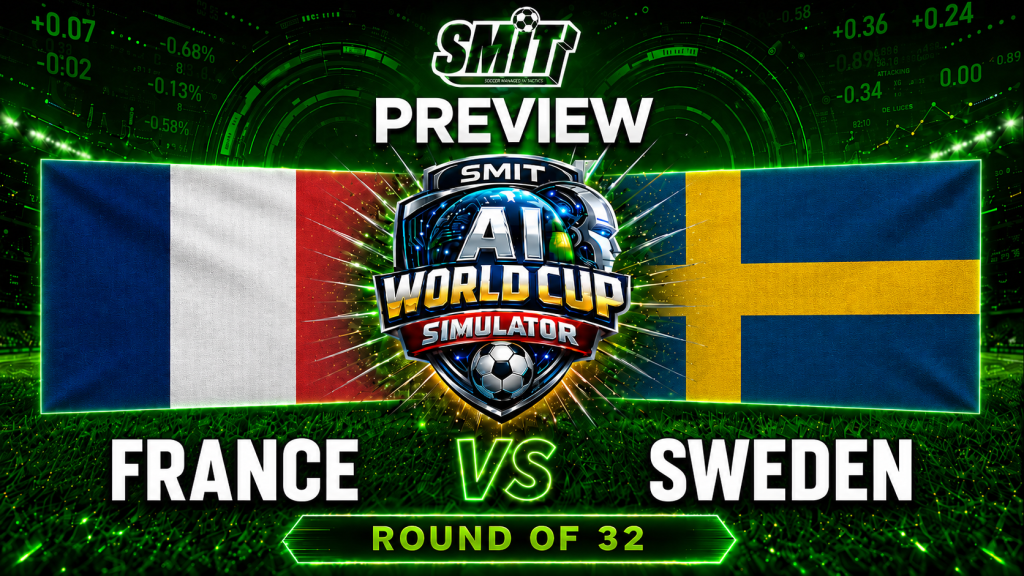
France and Sweden meet at New York/New Jersey Stadium in a Round of 32 matchup that puts one of the tournament favorites against one of the most dangerous outsiders left in the World Cup. Les Bleus arrive perfect from the group stage, loaded with attacking firepower and chasing one final triumph under Didier Deschamps. Sweden enter as underdogs, but with Viktor Gyökeres, Alexander Isak and Anthony Elanga, the Blågult have enough speed and power to make this knockout tie uncomfortable.
The Big Picture
France enter the knockout stage looking every bit like a title contender.
Didier Deschamps’ side swept through Group I with three wins from three matches, scoring 10 goals and conceding only two. The run included a 3-1 win over Senegal, a controlled 3-0 victory against Iraq and a statement 4-1 result against Norway. With Kylian Mbappé, Ousmane Dembélé, Michael Olise and Désiré Doué all operating around a powerful midfield base, France have one of the most complete attacking profiles in the tournament.
This World Cup also carries special meaning for Deschamps. After winning the trophy as a player in 1998, lifting it as coach in 2018 and reaching the final again in 2022, he is chasing one last deep run with Les Bleus. France are built to win now, and anything short of a serious title push would feel below expectation.
Sweden’s path has been far more chaotic. Graham Potter’s team arrived at the tournament after a controversial and unusual qualification route, then came through Group F as one of the best third-place teams. The Blågult opened with a 5-1 win over Tunisia, suffered a heavy 5-1 defeat to the Netherlands and then secured qualification with a 1-1 draw against Japan.
Sweden are not as balanced as France, but they are dangerous. Gyökeres gives them a powerful central striker, Isak adds elite movement and finishing, and Elanga gives them speed in transition. If Sweden can survive long stretches without the ball and attack France’s high line quickly, they have a path into the game.
But the matchup is brutal. France have speed, depth, form and a much stronger defensive platform. Sweden will need near-perfect efficiency to turn this into a real upset chance.
Recent Form
France arrive in one of the strongest runs of any team in the Round of 32.
Across the last five matches provided, Les Bleus have four wins and one loss, with 14 goals scored and five conceded. The only defeat came in a pre-tournament friendly against Ivory Coast. Since then, France have won four straight and have raised their level inside the World Cup.
Using the SMIT knockout-stage model — 70 percent weight on the three World Cup group-stage matches and 30 percent on the previous recent fixtures — France receive an elite form score. Their group-stage numbers are dominant: 10 goals scored, two conceded, three wins, three matches with at least three goals scored.
The attack is the defining story. France have been dangerous from wide areas, central combinations, pressing recoveries and individual moments. Mbappé remains the headline player, but Dembélé’s group-stage form has added another layer. Olise gives the team creativity and rhythm between the lines, while Doué brings unpredictability and acceleration.
The defensive trend is also strong. France conceded once against Senegal and once against Norway, but they never looked structurally unstable for long stretches. With Maignan, Saliba, Upamecano, Koundé, Theo Hernandez, Tchouaméni and Rabiot, France have the athletic base to defend high and recover quickly.
Sweden’s form is much more volatile.
Across the last five matches provided, the Blågult have one win, two draws and two losses, with 10 goals scored and 12 conceded. The attacking numbers are not poor, but the defensive profile is a real concern. Sweden have conceded in each of their last five matches, and four of those five games went over 2.5 total goals.
In the World Cup group stage, Sweden scored seven and conceded seven. The 5-1 win over Tunisia showed the upside: direct attacks, aggressive forward runs and excellent finishing. The 5-1 loss to the Netherlands showed the risk: defensive gaps, spacing problems and difficulty controlling elite attacking movement. The 1-1 draw against Japan was more mature, but still required long defensive stretches.
The form model gives Sweden a dangerous attacking score but a weak defensive-stability score. Against France, that imbalance matters. Sweden can score, but the question is whether they can survive 90 minutes against one of the tournament’s most complete attacks.
Tactical Keys
France are expected to line up in a 4-2-3-1.
Mike Maignan should start in goal, with Jules Koundé, Dayot Upamecano, William Saliba and Theo Hernandez across the back line. Aurélien Tchouaméni and Adrien Rabiot are projected as the double pivot, giving France physicality, coverage and control in central midfield.
The attacking line is the most important part of the structure. Michael Olise, Ousmane Dembélé and Désiré Doué are expected to operate behind Kylian Mbappé. That gives France fluidity rather than a fixed attacking shape. Mbappé can start central but drift left. Dembélé can attack either side. Olise can create in the right half-space. Doué can receive between the lines and carry the ball through pressure.
France’s tactical goal will be to overload Sweden’s back five and force the Blågult defenders into repeated one-on-one decisions. If Sweden sit deep, France can circulate until Mbappé or Dembélé find isolation. If Sweden step forward, France can attack the space behind.
Sweden’s projected 3-4-3 is built for directness.
Jacob Widell Zetterström is expected in goal, with Gustaf Lagerbielke, Victor Lindelöf and Gabriel Gudmundsson forming the back three. The midfield line should include Alexander Bernhardsson, Yasin Ayari, Jesper Karlström and Elliot Stroud, with Anthony Elanga, Viktor Gyökeres and Alexander Isak as the front three.
With Isak Hien out, Sweden lose a major defensive piece. That forces Potter to rework the back line and places even more responsibility on Lindelöf’s positioning and communication.
Sweden’s best tactical route is not sustained possession. It is vertical attack. Win the ball, find Elanga or Isak early, and use Gyökeres as the physical reference point. France’s fullbacks will push forward, and Sweden must use those moments to attack quickly before Tchouaméni and Rabiot reset the defensive shape.
The key question: can Sweden defend long enough to make their transitions matter?
Team News
France have no confirmed injuries or suspensions listed in the material provided.
William Saliba had been a player to monitor after missing the Norway match with a back issue, but he is included in the supplied probable starting XI and is expected to play alongside Upamecano. That would restore France’s preferred central defensive balance.
Deschamps is projected to start Maignan in goal, Koundé and Theo Hernandez as fullbacks, and a midfield base of Tchouaméni and Rabiot. The attacking unit is expected to feature Olise, Dembélé, Doué and Mbappé.
France also have major options from the bench, including Marcus Thuram, Bradley Barcola, Rayan Cherki, Jean-Philippe Mateta, Maghnes Akliouche, N’Golo Kanté and Warren Zaïre-Emery. That depth gives Deschamps flexibility if the match becomes stretched or if Sweden force extra time.
Sweden will be without Isak Hien, who is out through injury. That is a major blow to Potter’s defensive plan because Hien’s athleticism and duel-winning would have been important against Mbappé and France’s rotating forwards.
The expected Swedish lineup has Zetterström in goal; Lagerbielke, Lindelöf and Gudmundsson in defense; Bernhardsson, Ayari, Karlström and Stroud across midfield; and Elanga, Gyökeres and Isak in attack.
There are no suspensions listed for Sweden in the material provided.
Key Battles
Kylian Mbappé vs Victor Lindelöf
Mbappé is the most dangerous player on the field and the one Sweden must build their entire defensive plan around. Lindelöf will need help, especially when Mbappé drifts into the left channel or attacks the space between center back and wingback. If Sweden allow Mbappé to receive facing goal, the match can break open quickly.
Ousmane Dembélé vs Gabriel Gudmundsson
Dembélé’s form gives France a second elite isolation threat. His two-footed dribbling can destroy defensive angles, and Gudmundsson must avoid getting caught square when Dembélé changes direction. Sweden may need to double-team this side, but doing so creates space for Olise and Koundé.
Viktor Gyökeres vs William Saliba
Gyökeres is Sweden’s best physical route into the game. He can hold the ball, run channels and turn direct passes into attacks. Saliba’s composure, strength and timing will be crucial. If Saliba controls this duel, Sweden lose a major outlet.
Alexander Isak vs Dayot Upamecano
Isak’s movement is different from Gyökeres. He is smoother, more elusive and dangerous when he drifts into pockets. Upamecano must track him without being pulled too far from the defensive line. Sweden’s best chance may come from Isak finding space off the shoulder in transition.
Aurélien Tchouaméni vs Yasin Ayari
Tchouaméni gives France balance. Ayari must try to disrupt him and prevent France from building with total comfort. If Tchouaméni controls the middle, France can pin Sweden back for long stretches. If Ayari helps break the first line, Sweden can release their front three quickly.
What’s at Stake
This is the Round of 32, but France will view it as the first serious step toward a title run.
Les Bleus are not just trying to advance. They are trying to reach a third straight World Cup final and give Deschamps a final chapter worthy of his era. A loss here would be a massive shock and would immediately reshape the tournament.
For Sweden, the stakes are different but just as meaningful. The Blågult reached the knockout stage after a difficult group and an unusual qualification path. Beating France would instantly turn a controversial road to the World Cup into one of the most memorable Swedish tournament moments in decades.
The winner will face Paraguay in the Round of 16 after La Albirroja eliminated Germany. That makes the opportunity even more significant. France would see a path opening toward the quarterfinals, while Sweden would have a realistic chance to follow a historic upset with another deep knockout push.
Probable Lineups
France Probable Lineup
Formation: 4-2-3-1
Mike Maignan; Jules Koundé, Dayot Upamecano, William Saliba, Theo Hernandez; Aurélien Tchouaméni, Adrien Rabiot; Michael Olise, Ousmane Dembélé, Désiré Doué; Kylian Mbappé.
Sweden Probable Lineup
Formation: 3-4-3
Jacob Widell Zetterström; Gustaf Lagerbielke, Victor Lindelöf, Gabriel Gudmundsson; Alexander Bernhardsson, Yasin Ayari, Jesper Karlström, Elliot Stroud; Anthony Elanga, Viktor Gyökeres, Alexander Isak.
SMIT AI WORLD CUP SIMULATOR
Squad Strength Index
| Team | Goalkeeping | Defense | Midfield | Attack | Depth | Total |
|---|---|---|---|---|---|---|
| France | 8.9 | 9.0 | 8.8 | 9.5 | 9.2 | 90.8 |
| Sweden | 7.3 | 7.0 | 7.4 | 8.5 | 7.2 | 74.8 |
France receive one of the highest Squad Strength Index totals of the Round of 32 because of elite attacking talent, defensive depth, midfield control and bench quality. Sweden score well in attack thanks to Gyökeres, Isak and Elanga, but Hien’s absence and recent defensive issues lower the overall rating.
Expected Goals Simulation
| Team | Projected xG | Shot Quality Trend | Defensive Risk | Set-Piece Threat |
| France | 2.42 | Very high | Low-to-medium | Medium-high |
| Sweden | 1.05 | Medium | High | High |
The simulation projects France to create the higher volume and better quality of chances through Mbappé, Dembélé, Olise and Doué. Sweden’s xG comes mainly from transition attacks, Gyökeres’ physical presence and set-piece situations.
Win Probability
| Outcome | Probability |
| France win in 90 minutes | 70% |
| Draw after 90 minutes | 18% |
| Sweden win in 90 minutes | 12% |
| France advance overall | 84% |
| Sweden advance overall | 16% |
France are clear favorites because of their group-stage dominance, attacking efficiency and superior defensive structure. Sweden’s upset path depends on counterattacking efficiency, set pieces and a standout goalkeeping performance.
Four Most Likely Results
| Result | Probability |
| France 3-1 Sweden | 19% |
| France 2-0 Sweden | 17% |
| France 2-1 Sweden | 15% |
| France 3-0 Sweden | 12% |
Most Likely Result
France 3-1 Sweden
The SMIT AI Simulator predicts France to advance to the Round of 16 with a 3-1 win after 90 minutes.
Predicted Goalscorers
France: Kylian Mbappé, Ousmane Dembélé, Michael Olise
Sweden: Viktor Gyökeres
Player of the Simulation
Kylian Mbappé, France
Mbappé is projected as the decisive player because of his speed, finishing, movement across the front line and ability to punish any defensive spacing error from Sweden.
Confidence Level
High
France have the stronger squad, better group-stage form, deeper bench and more balanced tactical profile. Sweden’s attacking talent keeps the upset scenario alive, but the defensive matchup strongly favors Les Bleus.
AI Match Simulation
The simulation begins with France immediately taking control of possession. Tchouaméni and Rabiot settle the rhythm in midfield, while Olise and Doué move into the half-spaces to pull Sweden’s midfield line out of shape. Sweden defend in a back five without the ball, with Lindelöf trying to organize a reshaped defensive unit missing Hien.
France’s first major chance comes through Dembélé. He isolates Gudmundsson on the right, shifts the ball onto his left foot and forces Zetterström into a low save. Sweden survive the early pressure and try to respond directly, with Elanga sprinting into space and Gyökeres battling Saliba for long balls.
The breakthrough arrives midway through the first half. France overload the right side through Koundé, Olise and Dembélé, then switch quickly into Mbappé’s channel. The French captain attacks the space between Lagerbielke and Lindelöf, takes one touch inside and finishes low into the far corner.
Sweden do not collapse. Potter’s side find a response through their best route: transition. Ayari wins a second ball in midfield and releases Isak, who slips a pass into Gyökeres. The striker uses his strength to hold off Saliba and fires a finish past Maignan to make it 1-1.
For a brief stretch, Sweden grow in belief. Elanga’s pace forces Theo Hernandez to defend deeper, and France have to manage a few uncomfortable minutes. But the difference in attacking variety soon reappears.
Late in the first half, Dembélé restores France’s lead. Olise receives between the lines, delays the pass just long enough to freeze the Swedish back line, and finds Dembélé in the box. The winger finishes sharply to make it 2-1.
In the second half, Sweden are forced to open up. That is exactly the game state France want. Mbappé starts finding more space in transition, Doué carries the ball through midfield, and Rabiot’s forward runs add pressure around the box.
The third goal arrives in the final 20 minutes. France win the ball high, Tchouaméni finds Olise, and the Bayern Munich playmaker curls a composed finish into the corner. At 3-1, the match is effectively under control.
Sweden push late through Isak and Elanga, but France’s defensive depth and pace prevent a real comeback. Deschamps uses the bench to slow the tempo, protect the lead and prepare for the next round.
According to the SMIT AI Simulator, France advance with a convincing 3-1 win — a performance built on attacking variety, elite individual quality and a level of control Sweden cannot match for 90 minutes.
Why the Simulator Predicts This Result
The simulation favors France for five main reasons.
First, France have the strongest current form profile. Their three World Cup group-stage wins produced 10 goals, only two conceded and a perfect nine-point finish. In the SMIT model, that group-stage performance carries 70 percent of the form weight, making France one of the highest-rated teams in the Round of 32.
Second, the attacking matchup heavily favors Les Bleus. Mbappé, Dembélé, Olise and Doué give France pace, creativity and finishing from multiple zones. Sweden have excellent forwards, but France have more creators and more ways to generate high-quality chances.
Third, Sweden’s defensive trend is a major concern. The Blågult have conceded 12 goals across the last five listed matches and allowed five against the Netherlands. Facing France without Isak Hien makes the defensive challenge even more difficult.
Fourth, France have the better midfield control. Tchouaméni and Rabiot give Deschamps the structure to manage transitions, while Sweden must rely on quick vertical attacks rather than long spells of possession.
Fifth, France’s bench creates a late-game advantage. If Sweden keep the match close, Deschamps can still turn to players such as Barcola, Thuram, Cherki, Mateta, Kanté or Zaïre-Emery. Sweden do not have the same depth of game-changing options.
The SMIT AI Simulator projects Sweden to score because of their front three and set-piece threat, but over 90 minutes France’s attacking power, defensive balance and tournament experience create a clear path to victory.